
Minimally Invasive Bunion Surgery Recovery: Week-by-Week Timeline & FAQ
A complete recovery guide for minimally invasive bunion surgery (MIS) — week-by-week timeline, pain management, weight-bearing milestones, return to work, driving, exercise, do's and don'ts, warning signs, and answers to the most common patient questions. Written by Dr. Andrew N. Eskander, DPM for patients in Irvine and Orange County.
Minimally Invasive Bunion Surgery Recovery: Week-by-Week Timeline & FAQ
Most patients researching minimally invasive bunion surgery (MIS) recovery want one honest answer: how soon can I walk, drive, work, and get back to my life? This guide gives you a realistic week-by-week timeline, what to expect for pain and swelling, when you can resume normal activities, the warning signs that should prompt a call to your surgeon, and clear answers to the questions we hear most often at Eskander Foot & Ankle in Irvine.
The short version: Most patients are walking in a surgical shoe immediately, off prescription pain medication within the first week, back to desk work in 1–2 weeks, in supportive sneakers by 4–6 weeks, and back to running and impact sports between 3 and 6 months — sometimes faster than traditional open surgery.
Why recovery is faster than traditional bunion surgery
Modern third- and fourth-generation MIS bunionectomy uses 2–5 incisions of 3–5 mm with a high-speed burr and percutaneous screw fixation under live X-ray guidance. Compared to a traditional 3–4 inch open incision, MIS preserves the soft-tissue envelope and the bone''s blood supply. The practical consequences for recovery are:
- Less swelling because there is no large dissection
- Less post-op pain because fewer nerves and tendons are disturbed
- Smaller, barely-visible scars
- Earlier protected weight-bearing in a surgical shoe
- A shorter window in the boot before transitioning to sneakers
For a direct technique comparison, see Minimally Invasive vs Traditional Bunion Surgery. For an overview of the procedure itself, see Minimally Invasive Bunion Surgery: A Complete Patient Guide.
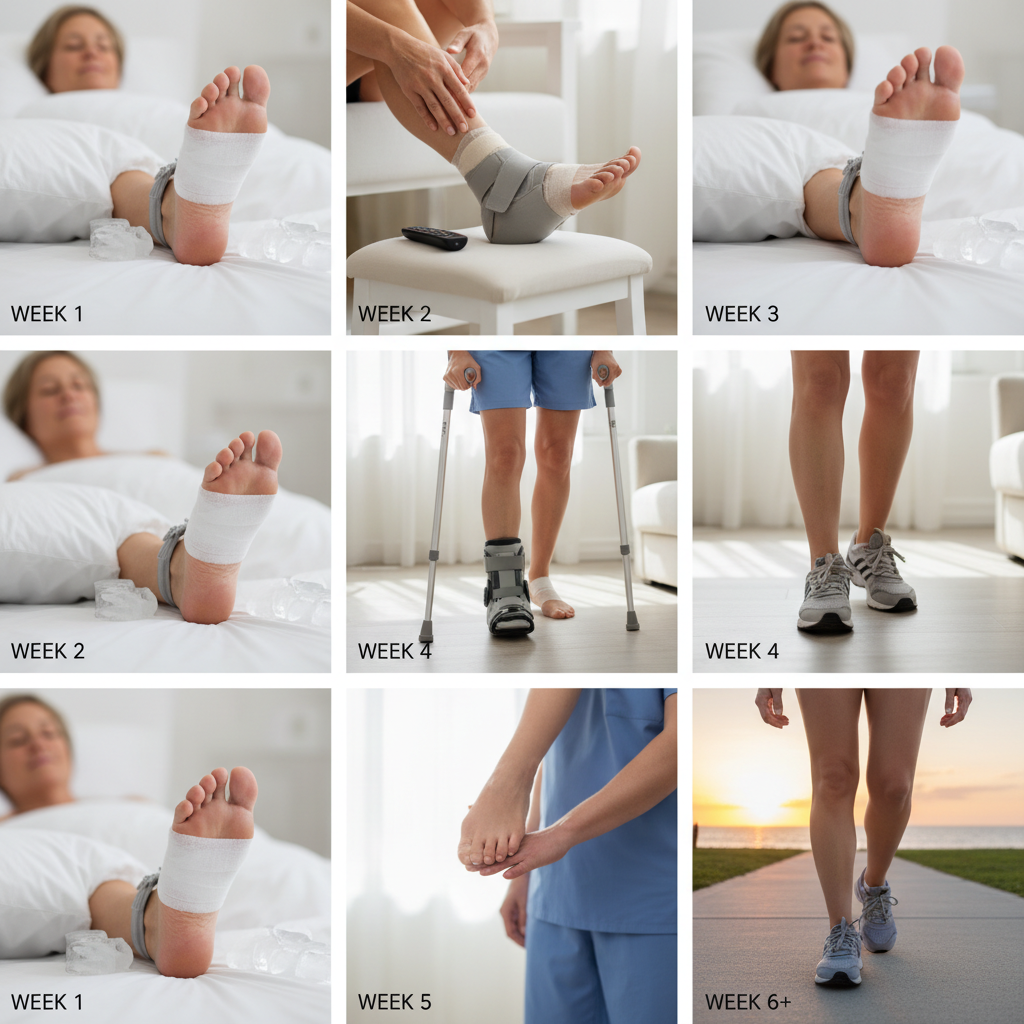
Week-by-week recovery timeline
The timeline below is typical for an uncomplicated MIS bunionectomy on a healthy adult. Your exact milestones depend on your anatomy, the specific osteotomy, your bone quality, and how closely you follow post-op instructions.
Day 0–3: Surgery day and the first 72 hours
- Walking: Protected weight-bearing in a stiff surgical shoe, heel-first. Most patients do NOT need crutches.
- Pain: Highest in the first 48 hours, then drops sharply. An ankle block typically keeps you comfortable for the first 12–24 hours.
- Swelling: Expected. Keep the foot elevated above heart level as much as possible.
- Do: Elevate, ice over the dressing (never directly on skin), hydrate, take prescribed medication on schedule.
- Don''t: Get the dressing wet, drive, or stand for long stretches.
Week 1: First post-op visit
- Walking: Short household trips in the surgical shoe. Sit and elevate between trips.
- Pain: Most patients transition from prescription pain medication to over-the-counter (acetaminophen and/or ibuprofen if approved).
- Dressing: Checked or changed at your post-op visit. X-rays may be taken to confirm alignment.
- Work: Desk work from home is often realistic if you can elevate the foot.
Week 2–3: Stitches out, swelling improving
- Walking: More confident walking in the surgical shoe. Short outings (groceries, light errands) are usually fine.
- Pain: Mild, intermittent. Mostly soreness with activity.
- Stitches: Removed around day 10–14 (depends on closure method).
- Showering: Once stitches are out and the wounds are sealed, most patients can shower with the foot exposed — confirm with your surgeon.
Week 4–6: Transition to sneakers
- Footwear: Most MIS patients transition from the surgical shoe to a wide, supportive sneaker between week 4 and week 6.
- Walking: Normal walking distances return. A slight limp is common as the foot remodels.
- Driving: Right-foot surgery — usually safe to drive once you''re comfortably out of the surgical shoe and can perform an emergency stop without pain (typically 4–6 weeks). Left-foot surgery with an automatic — often sooner.
- Swelling: Still present, especially at the end of the day. Elevation and a compression sock help.
Week 6–12: Building back activity
- Low-impact exercise: Stationary bike, elliptical, swimming, and upper-body weights are usually cleared in this window.
- Walking: Long walks (30–60 minutes) become comfortable.
- Work: Patients with standing or walking jobs (nursing, teaching, retail) typically return in this window with supportive footwear.
Month 3–6: Return to running and impact sports
- Running: Usually cleared around month 3–4 if X-rays show solid bone healing and you have full, pain-free range of motion.
- Hiking, tennis, pickleball, court sports: Reintroduce gradually starting around month 3–4.
- Heels and narrow dress shoes: Most patients can wear them for short events by month 4–6.
Month 6–12: Full remodeling
- Final swelling resolves, the scars fade, and the foot reaches its long-term shape. Most patients report the foot feels essentially normal by 6–12 months.
At-a-glance return-to-activity table
| Activity | Typical MIS recovery time |
|---|---|
| Walk in surgical shoe | Day 0 |
| Off prescription pain meds | 3–7 days |
| Desk work from home | 1–2 weeks |
| Shower with foot exposed | ~2 weeks (after stitches out) |
| Drive (right foot) | 4–6 weeks |
| Sneakers | 4–6 weeks |
| Standing / walking job | 6–10 weeks |
| Low-impact exercise | 6–10 weeks |
| Running | 3–4 months |
| Heels / dress shoes | 4–6 months |
| Final cosmetic result | 6–12 months |
Ranges are typical guidance, not promises. Your surgeon''s instructions always override a general table.
Pain management after MIS bunion surgery
A well-planned multi-modal pain plan keeps most MIS patients comfortable with very modest opioid use:
- Ankle block at the time of surgery for the first 12–24 hours of comfort
- Scheduled acetaminophen + ibuprofen (if approved by your surgeon) for the first 5–7 days
- A small prescription for stronger pain medication used only at night for the first few days
- Ice and elevation — the two cheapest, most effective tools you have
- Movement of the ankle, knee, and hip to prevent stiffness and blood clots
Call your surgeon if pain is increasing after day 3, if pain wakes you from sleep after the first week, or if medication is no longer controlling it — these are not normal and warrant a check.
Swelling: what''s normal and what to do about it
Some swelling is normal for up to 6 months after any bunion surgery. To minimize it:
- Elevate the foot above heart level whenever you sit or lie down
- Ice for 15–20 minutes a few times a day
- Wear a graduated compression sock once your surgeon clears it
- Avoid long stretches of standing or dangling the foot in the first 6 weeks
Warning signs: sudden new swelling in the calf or one-sided leg swelling can indicate a blood clot — call your surgeon or go to urgent care.
Do''s and don''ts checklist
Do:
- Wear the surgical shoe every step you take until your surgeon clears sneakers
- Elevate, elevate, elevate
- Keep follow-up visits — X-rays confirm bone healing on schedule
- Use orthotics if recommended to address the mechanics that caused the bunion
- Hydrate, eat protein, and (if you smoke) stop — bone healing is dramatically slower with nicotine
Don''t:
- Walk barefoot or in slippers in the first 6 weeks
- Soak the foot (bath, pool, hot tub) until your surgeon clears it
- Push into pain — discomfort is fine, sharp pain is a signal
- Return to running, jumping, or court sports before clearance
- Rush back into heels or narrow shoes — they''re often what created the bunion
Warning signs that need a call
Contact your surgeon promptly if you notice:
- Fever over 101°F (38.3°C)
- Increasing redness, warmth, or drainage from any incision
- A foul odor from the dressing
- Pain that is worsening after the first 3 days
- Sudden one-sided calf or leg swelling, or chest pain / shortness of breath (possible blood clot — seek emergency care)
- Numbness or color change in the toes that does not resolve with elevation
Frequently asked questions
How painful is minimally invasive bunion surgery recovery?
Most patients describe the first 48 hours as the worst, controlled well with a combination of an ankle block, acetaminophen, ibuprofen (if cleared), and a small amount of stronger medication. By the end of week one most patients are on over-the-counter pain relievers only.
Can I walk after MIS bunion surgery?
Yes. Most MIS patients walk in a stiff surgical shoe immediately. Crutches are rarely needed for an uncomplicated MIS bunionectomy.
When can I drive after MIS bunion surgery?
For right-foot surgery, most patients drive comfortably between week 4 and week 6, once they are out of the surgical shoe and can perform an emergency stop without pain. For left-foot surgery with an automatic, often sooner. Never drive while taking prescription pain medication.
When can I return to work?
Desk work from home: 1–2 weeks. In-office desk work: 2–3 weeks. Jobs requiring standing or walking: typically 6–10 weeks with supportive footwear.
When can I exercise again?
Low-impact (stationary bike, elliptical, swimming, upper-body weights): around 6–10 weeks. Running: usually around 3–4 months once X-rays confirm healing. Court sports and hiking: 3–4 months. Build back gradually — sudden volume increases drive flare-ups.
How long until I can wear heels or dress shoes?
Most patients can wear heels for short events by 4–6 months. Daily heel wear isn''t ideal long-term for any foot, especially a recently corrected one.
How long does swelling last?
Mild end-of-day swelling can persist for 3–6 months and occasionally longer. Elevation, ice, and compression socks help. Persistent or worsening swelling deserves a check.
Will my scars be visible?
MIS scars are 3–5 mm and typically barely visible at 6 months. Sun protection during the first year improves the final appearance.
What if my bunion comes back?
Recurrence is uncommon when the right procedure is matched to the deformity and you address the underlying mechanics (orthotics, footwear, strength). For more on technique selection, see our MIS vs traditional comparison.
Set yourself up for the best possible recovery
The biggest predictors of a smooth MIS bunion recovery are:
- A surgeon specifically trained in modern MIS technique and percutaneous fixation
- Strict adherence to weight-bearing and shoe-wear instructions
- Aggressive elevation and icing in the first 2 weeks
- Patience during the sneaker-to-running transition (months 2–4)
- Addressing the underlying foot mechanics with orthotics or footwear changes so the bunion doesn''t come back
How Dr. Eskander supports patients through recovery
Dr. Andrew N. Eskander, DPM is a residency-trained, Chief-Resident-trained foot and ankle surgeon serving Irvine and Orange County. Every MIS bunion patient gets a written week-by-week recovery plan, scheduled follow-ups with X-rays at each major milestone, direct access to the practice for questions, and clear guidance on when to advance activity — not a generic protocol.
Book a bunion consultation in Irvine
If you''re weighing bunion surgery and want a clear answer on whether minimally invasive correction is right for you — and what your specific recovery would look like — a consultation is the fastest way to know. Eskander Foot & Ankle is located at 18021 Sky Park Circle, Suite G, Irvine, CA 92614 and serves patients across Orange County including Woodbridge, Turtle Rock, Quail Hill, Northwood, Tustin, Newport Beach, and Costa Mesa.
Call (949) 774-2890 or book online to schedule an evaluation.
This article is for general educational purposes and is not a substitute for individualized medical advice. Always follow your surgeon''s specific post-operative instructions.