
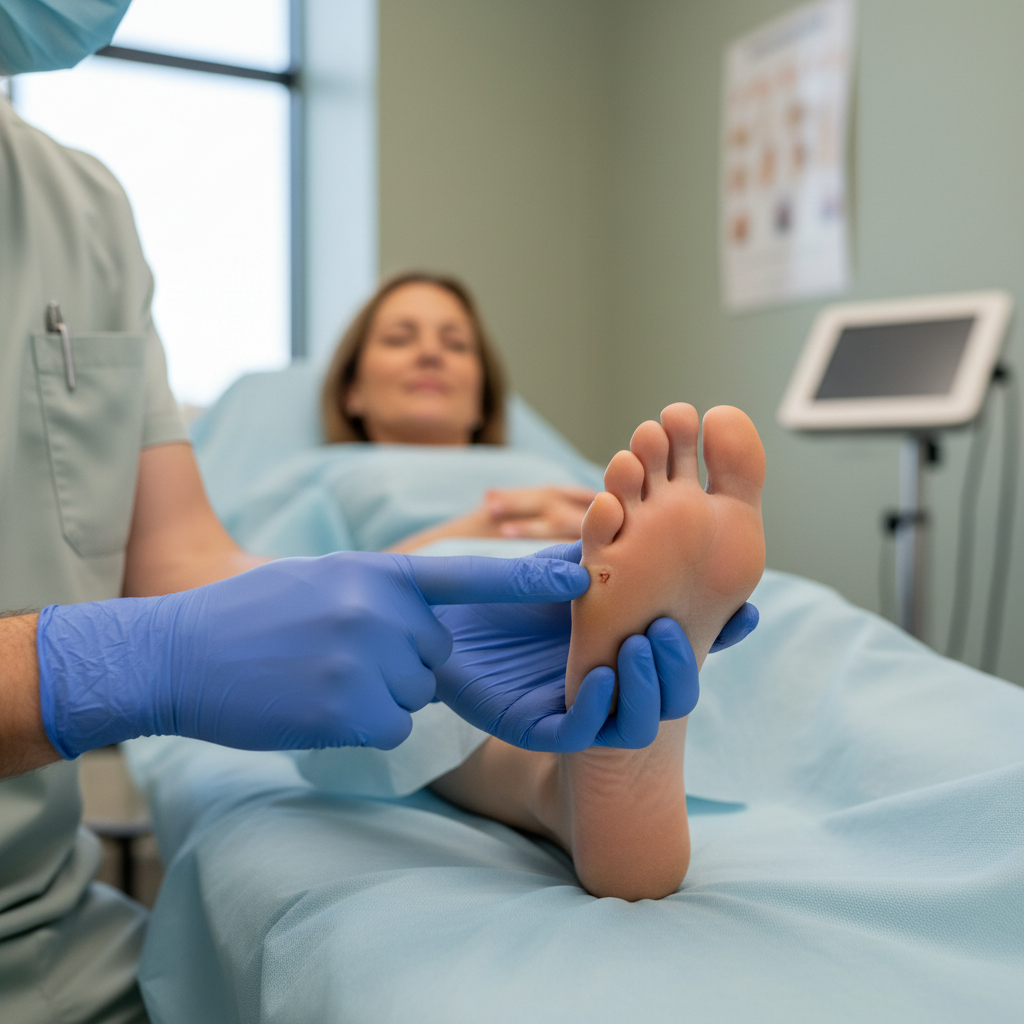
Minimally Invasive Bunion Surgery: A Complete Patient Guide
A complete patient guide to minimally invasive bunion surgery (MIS) — how the procedure works, who is a good candidate, benefits over traditional surgery, what the day-of looks like, and what recovery involves. Written for patients in Irvine and Orange County.
Minimally Invasive Bunion Surgery: A Complete Patient Guide
Minimally invasive bunion surgery (often shortened to MIS bunion surgery or percutaneous bunionectomy) is a modern way to correct a bunion through a handful of small incisions instead of one long open cut. For the right patient it means less soft-tissue trauma, smaller scars, and a quicker early recovery. This guide walks you through how it works, who it''s for, and what to expect.
What is a bunion?
A bunion (hallux valgus) is a structural deformity where the first metatarsal drifts outward and the big toe drifts inward, creating a painful bump on the inside of the foot. Bunions are progressive — they don''t get better on their own — and they''re driven mostly by foot mechanics and genetics, not just footwear. When pain, shoe fit, or activity limitations no longer respond to conservative care (wider toe boxes, custom orthotics, padding, anti-inflammatories), surgery becomes the definitive fix.
How minimally invasive bunion surgery works
In a third- or fourth-generation MIS bunionectomy, the surgeon makes 2 to 5 incisions, each about 3–5 mm long. Through these tiny portals the surgeon:
- Uses a specialized high-speed burr to cut the first metatarsal (the osteotomy) under live X-ray guidance (fluoroscopy).
- Realigns the bone into the correct anatomic position.
- Fixes the correction with percutaneous screws placed through the skin.
- Releases tight soft tissues as needed, again through small portals.
There is no large open dissection, no stripping of the periosteum, and minimal disruption of the joint capsule. The skin is closed with a stitch or two per portal.
Benefits compared to traditional open surgery
| Benefit | Why it matters |
|---|---|
| Smaller incisions (3–5 mm) | Minimal scarring — barely visible at 6 months |
| Less soft-tissue trauma | Less post-op swelling and typically less pain |
| Preserved blood supply | Bone heals reliably with fewer wound complications |
| Faster early recovery | Many patients are in sneakers by 4–6 weeks |
| Quicker return to light activity | Walking, desk work, and driving resume sooner |
For a direct comparison, see Minimally Invasive vs Traditional Bunion Surgery.
Who is a good candidate?
MIS bunion surgery is best suited for patients with:
- Mild to moderate hallux valgus deformity
- A big-toe joint that is not severely arthritic
- Reasonable bone quality
- Realistic expectations and willingness to follow weight-bearing instructions
- A desire for minimal scarring and a faster early recovery
You may not be the best candidate for a pure MIS approach if you have a very severe deformity, prior failed bunion surgery, significant joint arthritis, or instability requiring fusion. In those cases an open, combined, or fusion-based correction tends to be more reliable. Your surgeon will use weight-bearing X-rays to make the call.
What the day of surgery looks like
- Anesthesia: Usually a local ankle block plus light sedation. General anesthesia is rarely needed.
- Procedure time: Approximately 30–60 minutes for a straightforward MIS bunionectomy.
- Going home: Same day. You''ll leave in a surgical shoe or boot with a soft dressing.
- Weight-bearing: Most MIS protocols allow protected weight-bearing in the surgical shoe right away — you do not need crutches in most cases.
Recovery timeline at a glance
- Day 0–3: Elevate, ice, take prescribed pain medication. Walk only as needed.
- Week 1–2: First post-op visit, X-rays, dressing change.
- Week 2–4: Stitches removed. Walking increases gradually.
- Week 4–6: Transition from surgical shoe to supportive sneakers.
- Month 2–3: Low-impact exercise (stationary bike, swimming, elliptical).
- Month 3–6: Return to running, hiking, and higher-impact sports.
For a detailed week-by-week breakdown, see Minimally Invasive Bunion Surgery Recovery: A Week-by-Week Guide.
Risks and realistic expectations
Every surgery carries risk. With MIS bunionectomy these include infection, recurrence, stiffness, nerve irritation, hardware irritation, and delayed bone healing. In experienced, MIS-trained hands these complications are uncommon and outcomes are excellent — but no surgeon can guarantee a perfect result. The goal is a pain-free, well-aligned foot that fits comfortably in normal shoes — not a cosmetic transformation.
How to get the best result
- Choose a surgeon specifically trained in modern MIS technique and percutaneous fixation
- Follow the post-op weight-bearing and shoe-wear instructions exactly
- Wear the prescribed surgical shoe / sneaker transition long enough — don''t rush back to heels or running
- Keep follow-up visits; X-rays confirm the bone is healing on schedule
- Use orthotics if recommended to address the underlying mechanics that caused the bunion
How Dr. Eskander approaches MIS bunion surgery
Dr. Andrew N. Eskander, DPM is a residency-trained, Chief-Resident-trained foot and ankle surgeon serving Irvine and Orange County. His philosophy is conservative first, surgical when appropriate, and when surgery is the right answer he matches the technique to the deformity — modern minimally invasive correction for mild to moderate bunions, and open or combined procedures for more complex cases. Every plan is built around your anatomy, your activity goals, and a realistic recovery timeline.
Schedule a bunion consultation
If a bunion is limiting your shoes, your workouts, or your daily comfort, a consultation is the fastest way to know whether minimally invasive surgery is right for you. Eskander Foot & Ankle is located at 18021 Sky Park Circle, Suite G, Irvine, CA 92614 and serves patients across Orange County including Woodbridge, Turtle Rock, Quail Hill, Northwood, Tustin, Newport Beach, and Costa Mesa.
Call (949) 774-2890 or book online to schedule an evaluation.
This article is for general educational purposes and is not a substitute for individualized medical advice.