
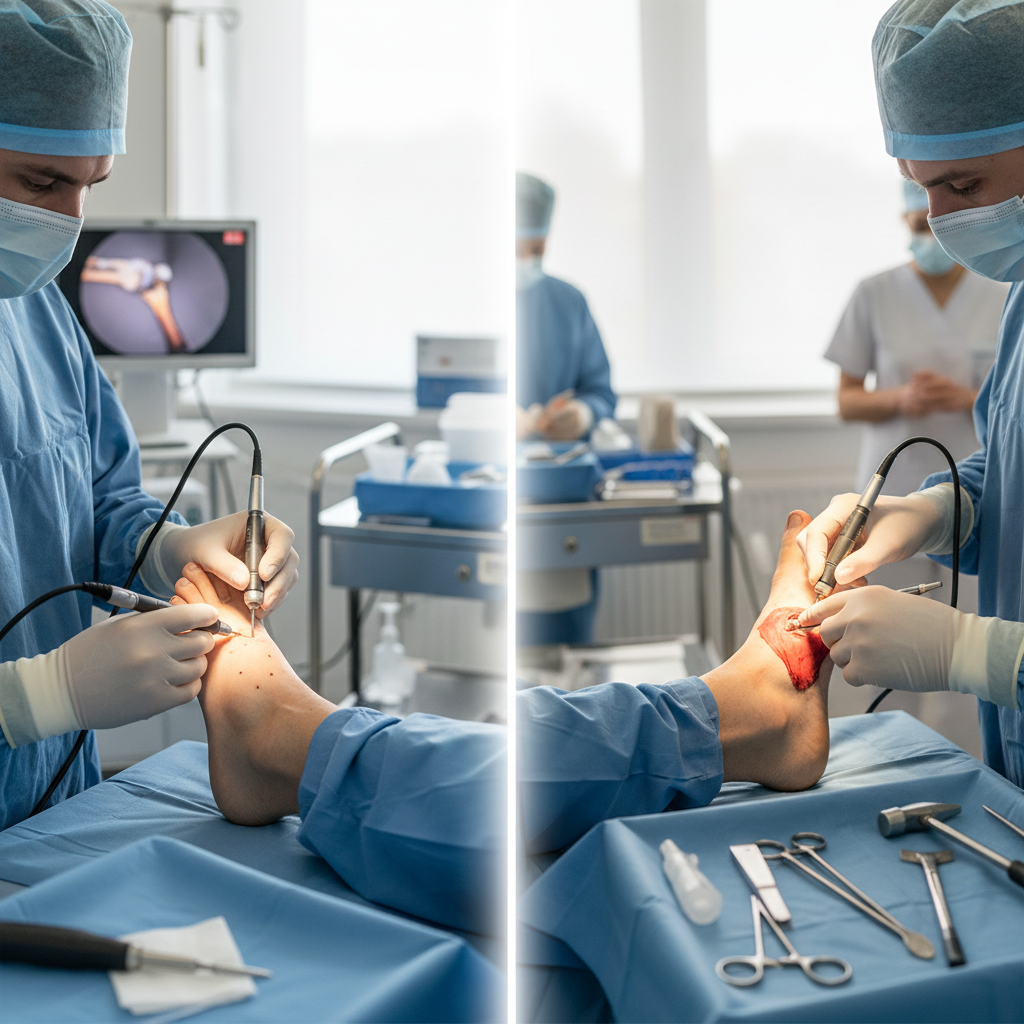
Minimally Invasive vs Traditional Bunion Surgery: Which Is Right for You?
A detailed comparison of minimally invasive bunion surgery (MIS) and traditional open bunionectomy — recovery time, scarring, pain, candidacy, and long-term outcomes — to help patients in Irvine and Orange County choose the right approach.
Minimally Invasive vs Traditional Bunion Surgery: Which Is Right for You?
If you''re considering bunion surgery, you''ve likely come across two very different options: minimally invasive bunion surgery (MIS) and traditional open bunionectomy. Both correct the underlying deformity, but they differ meaningfully in incision size, recovery, scarring, and which patients are good candidates. This guide breaks down the trade-offs so you can have an informed conversation with your podiatrist.
What is a bunion, briefly
A bunion (hallux valgus) is a bony bump at the base of the big toe caused by a misalignment of the first metatarsal. Over time it can cause pain, shoe-fitting problems, and arthritis in the joint. When conservative care (wider shoes, orthotics, padding, anti-inflammatories) no longer controls symptoms, surgery is considered.
Traditional open bunion surgery
Traditional bunionectomy uses a 3–4 inch incision along the top or side of the foot. The surgeon directly visualizes the bone, cuts (osteotomy) and realigns the first metatarsal, and fixes it with screws or plates.
Strengths
- Long, well-documented track record
- Direct visualization for complex or severe deformities
- Effective for revisions and arthritic joints
Trade-offs
- Longer incision and more visible scar
- More soft-tissue disruption → more post-op swelling and pain
- Typically 6–8 weeks in a surgical shoe/boot before sneakers
- Return to athletic activity often 3–6 months
Minimally invasive bunion surgery (MIS)
Modern third- and fourth-generation MIS techniques use 2–5 small incisions (3–5 mm). The surgeon performs the osteotomy with a specialized burr under live X-ray (fluoroscopy) and fixes the bone with percutaneous screws.
Strengths
- Tiny incisions, minimal scarring
- Less soft-tissue trauma → typically less post-op pain and swelling
- Faster early recovery: many patients are in sneakers around 4–6 weeks
- Often a quicker return to low-impact activity
Trade-offs
- Best suited for mild to moderate deformities — severe bunions or significant arthritis may still need an open approach
- Requires a surgeon specifically trained in MIS techniques and fluoroscopy
- Long-term outcomes are excellent in trained hands, but the technique is newer than open bunionectomy
Side-by-side comparison
| Feature | Minimally Invasive (MIS) | Traditional Open |
|---|---|---|
| Incision size | 2–5 incisions, 3–5 mm | Single 3–4 in incision |
| Soft-tissue disruption | Minimal | Moderate |
| Scarring | Barely visible | Visible linear scar |
| Time in surgical shoe | ~2–4 weeks | ~4–6 weeks |
| Back to sneakers | ~4–6 weeks | ~6–8 weeks |
| Return to running | ~3–4 months | ~4–6 months |
| Best for | Mild–moderate deformity | Any severity, revisions, arthritic joints |
Recovery ranges are typical guidance; your actual timeline depends on the procedure, your anatomy, and how closely you follow post-op instructions.
Who is a good candidate for MIS?
You may be a candidate for minimally invasive bunion surgery if:
- Your bunion is mild to moderate
- The big-toe joint is not severely arthritic
- You have realistic expectations and can follow weight-bearing instructions
- You want minimal scarring and a faster early recovery
MIS may not be the right choice if you have a very severe deformity, prior failed bunion surgery, significant joint arthritis, or instability that requires fusion. In those cases an open or combined approach gives more reliable correction.
What recovery looks like
Whichever technique you choose, expect a similar arc:
- Week 0–2: Surgical shoe, elevate the foot, ice, limit walking
- Week 2–4: Stitches removed, gradual increase in walking
- Week 4–6: Transition to supportive sneakers (sooner with MIS)
- Month 2–3: Low-impact activity (stationary bike, swimming)
- Month 3–6: Return to running and higher-impact sports
For a deeper week-by-week breakdown of MIS recovery, see our companion guide: Minimally Invasive Bunion Surgery Recovery: A Week-by-Week Guide.
How Dr. Eskander approaches bunion surgery
Dr. Andrew N. Eskander, DPM is a residency-trained, Chief-Resident-trained foot and ankle surgeon serving Irvine and Orange County. His approach is conservative first — orthotics, footwear changes, and activity modification when those will help — and surgical when appropriate, with the technique matched to your specific deformity and goals. He performs both modern MIS and traditional open bunion procedures and will walk you through which is the better fit for your foot.
Ready to talk through your options?
If bunion pain is limiting your shoes, your workouts, or your day, a consultation is the fastest way to know which procedure fits you. Eskander Foot & Ankle is located at 18021 Sky Park Circle, Suite G, Irvine, CA 92614 and serves patients across Orange County including Woodbridge, Turtle Rock, Quail Hill, Northwood, Tustin, Newport Beach, and Costa Mesa.
Call (949) 774-2890 or book online to schedule an evaluation.
This article is for general educational purposes and is not a substitute for individualized medical advice.