
Minimally Invasive Bunion Surgery in Irvine: What to Expect
A patient-friendly guide to minimally invasive bunion surgery (MIS) — how it differs from traditional correction, who is a candidate, the recovery timeline, and what to expect in Irvine and Orange County.
For decades, fixing a painful bunion meant a large incision, visible scarring, and weeks of strict non-weight-bearing recovery. Minimally invasive bunion surgery (MIS) has changed that conversation. Using small percutaneous incisions, specialized burrs, and internal screw fixation, an experienced foot and ankle surgeon can now realign the bone with less soft-tissue trauma — and often a faster, more comfortable recovery.
This guide explains what MIS bunion surgery actually is, who is a good candidate, how recovery compares to traditional surgery, and what Orange County patients can expect when they choose the procedure in Irvine.
What is minimally invasive bunion surgery?
A bunion (hallux valgus) is not a growth — it is the bone of the first metatarsal drifting out of alignment, pushing the big toe inward. Correcting it requires cutting the bone and shifting it back into a straight position.
In traditional bunion surgery, the surgeon makes a 4–6 cm incision along the inside of the foot, opens the soft tissue, cuts and repositions the bone, and fixes it in place with screws or a plate.
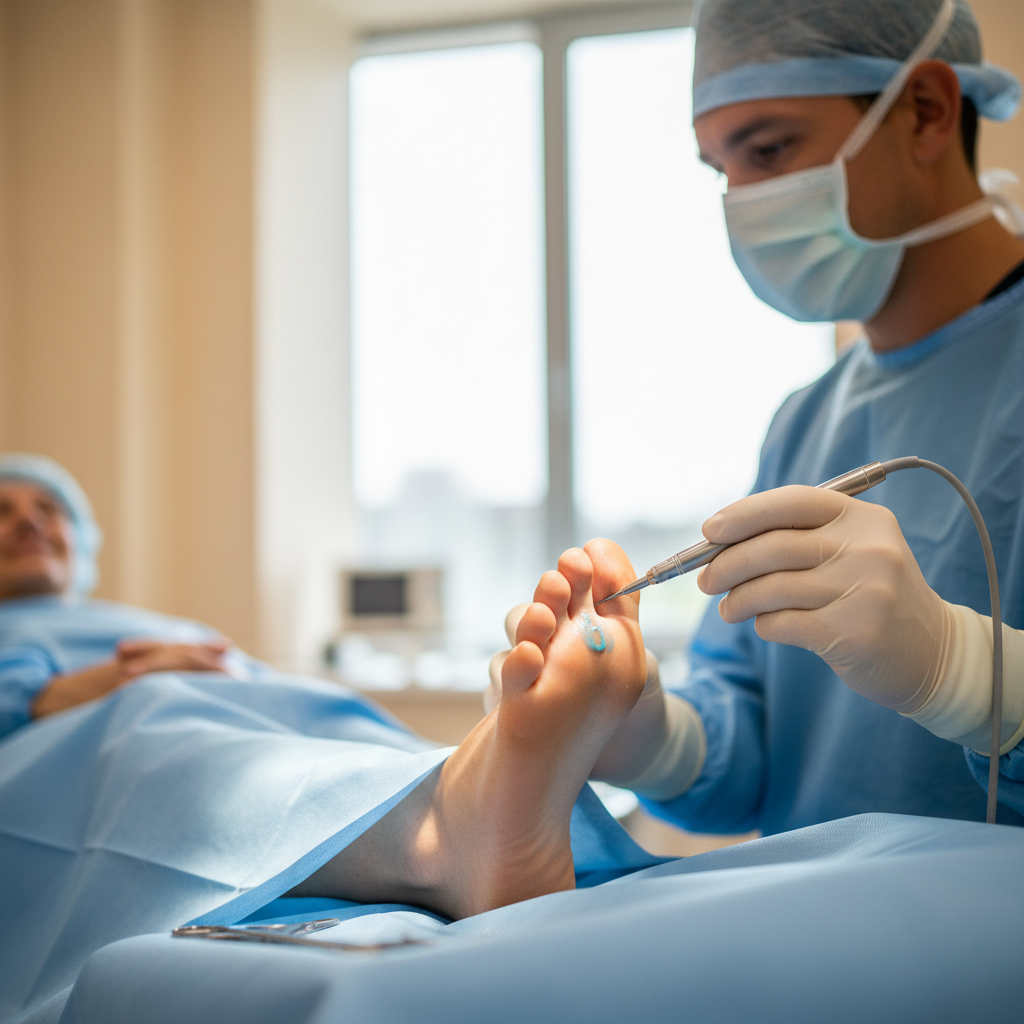
In minimally invasive bunion surgery, the same bone correction is performed through several 3–5 mm percutaneous incisions using a low-speed, high-torque rotary burr (similar in concept to what an orthopaedic surgeon uses in arthroscopy). The bone fragments are then realigned and fixed with one or two internal screws placed through the small incisions.
The goal is the same — a straight, stable, pain-free big toe — but the path to get there preserves more of the soft tissue around the joint.
How is it different from traditional bunion surgery?
| Feature | Traditional (open) | Minimally invasive (MIS) |
|---|---|---|
| Incision size | One 4–6 cm incision | Several 3–5 mm incisions |
| Soft tissue trauma | Moderate | Minimal |
| Scarring | Visible linear scar | Tiny dot scars that often fade |
| Early weight-bearing | Variable; often delayed | Usually allowed in a surgical shoe day 1 |
| Post-op pain | Moderate, often needs stronger meds | Generally lower in the first 2 weeks |
| Suitable for severe deformity | Yes, including reconstruction | Mild to moderate-severe with the right technique |
| Surgeon experience required | Standard training | Specialized MIS training and equipment |
Both approaches use modern screw fixation and both can produce excellent long-term results. The right choice depends on the specific deformity, bone quality, and the surgeon's training — not on marketing alone.
Am I a candidate for MIS bunion surgery?
Good candidates typically have:
- A mild, moderate, or moderate-to-severe bunion that has not responded to conservative care (wider shoes, orthotics, padding, activity modification).
- Healthy bone with no significant osteoporosis or osteonecrosis.
- No active infection on the foot or toe.
- Reasonable expectations about recovery — MIS is faster, not instant.
- A willingness to follow post-op instructions, especially regarding elevation and gradual return to activity.
MIS may not be the best choice when there is severe arthritis of the big toe joint, a very large or complex deformity that requires fusion (such as the Lapidus procedure), or significant instability of the midfoot. In those cases, a traditional reconstructive approach or a different procedure entirely may produce a better long-term result.
Only a thorough in-person evaluation with weight-bearing X-rays can tell you which procedure is right for your foot.
What to expect on the day of surgery
MIS bunion surgery is typically performed as an outpatient procedure under regional anesthesia (an ankle or popliteal block) with sedation. You go home the same day in a stiff-soled post-operative shoe.
A typical day looks like:
- Arrive at the surgery center about 90 minutes before your procedure.
- The anesthesia team places a regional block — your foot will be numb for many hours after surgery.
- The surgery itself usually takes 30–60 minutes.
- You spend 30–60 minutes in recovery, then go home with a friend or family member.
- The first 24–48 hours are spent with your foot elevated above heart level.
MIS recovery timeline
Individual recovery varies, but most patients follow a predictable curve. (For a full week-by-week guide that applies to both MIS and traditional procedures, see our bunion surgery recovery timeline.)
- Week 1: Aggressive elevation and icing. Limited weight-bearing in the surgical shoe as directed. First follow-up around days 7–10.
- Weeks 2–3: Swelling peaks, then begins to settle. Most patients are off stronger pain medication. Steri-strips replace stitches.
- Weeks 4–6: Increased weight-bearing in the surgical shoe. Range-of-motion exercises for the big toe begin. First post-op X-ray confirms bone alignment.
- Weeks 6–8: Transition to a wide, supportive athletic shoe. Most desk workers are fully back at work; many patients with standing jobs return at this stage.
- Months 3–4: Low-impact activity (cycling, swimming, elliptical) is usually cleared.
- Months 4–6: Graded return to running, hiking, and higher-impact exercise for most patients.
- Months 6–12: Final swelling resolution and full bone remodeling.
Compared to traditional open bunion surgery, MIS patients often report less post-op pain in the first 2 weeks, smaller and less noticeable scarring, and earlier comfort in regular shoes. The end result — a straight, stable, pain-free big toe — is the same goal for both techniques.
Risks and realistic expectations
No surgery is risk-free. Possible complications of bunion surgery, MIS or traditional, include:
- Infection
- Delayed bone healing or non-union
- Recurrence of the deformity
- Stiffness of the big toe joint
- Nerve irritation or numbness near the incision
- Hardware irritation (rare)
- Blood clot (rare)
These risks are minimized by choosing an experienced surgeon, following weight-bearing instructions, elevating in the first two weeks, and avoiding nicotine, which dramatically slows bone healing.
Choosing a bunion surgeon in Orange County
When evaluating a bunion surgeon, ask:
- How many bunion corrections — and specifically MIS corrections — do you perform each year?
- What is your preferred technique for my deformity, and why?
- What does the typical recovery look like for your patients?
- Where is the surgery performed, and which hospitals or surgery centers do you operate at?
- What happens if I have a complication?
Dr. Andrew N. Eskander, DPM is a residency-trained foot and ankle surgeon serving Irvine and all of Orange County. The practice offers both minimally invasive and traditional bunion correction, tailored to your foot, your activity level, and your goals — with surgical privileges at leading OC hospitals and surgery centers including Hoag, UCI Health, Orange Coast Medical Center, MemorialCare, Saddleback, and Los Alamitos.
The bottom line
Minimally invasive bunion surgery is not magic, and it is not the right procedure for every patient — but in the right foot, performed by a surgeon with the specific training and equipment, it can deliver the same straight, stable correction as traditional surgery with smaller scars and a smoother early recovery.
If you are considering bunion surgery in Irvine or anywhere in Orange County, call (949) 774-2890 to schedule a consultation. We will examine your foot, review weight-bearing X-rays with you, and walk through which technique is genuinely the best fit for your case — no pressure, no sales pitch.