Bunion Surgery Recovery Timeline: A Week-by-Week Guide
A practical week-by-week guide to bunion surgery recovery — pain management, footwear transitions, weight-bearing milestones, and when you can return to work, driving, and exercise.
Bunion surgery (hallux valgus correction) can dramatically reduce pain and restore foot function — but the recovery is a marathon, not a sprint. Knowing what to expect each week helps you plan time off work, prepare your home, and avoid the most common setbacks.
This is a general timeline based on modern surgical techniques and published podiatric guidelines. Your individual recovery depends on the specific procedure, your bone health, how closely you follow weight-bearing instructions, and whether you smoke. Always follow the plan your surgeon gives you.
How long is bunion surgery recovery, overall?
Most patients are back in a regular shoe by 6–8 weeks and back to low-impact activity by 3 months. Full bone healing and final swelling resolution typically take 6–12 months. Minimally invasive (MIS) procedures and modern Lapidus or Lapiplasty fixation often allow earlier weight-bearing than traditional osteotomies.
Week 0: Surgery day and the first 72 hours
- What happens: Procedure is usually outpatient under local or regional anesthesia with sedation. You go home the same day in a surgical shoe or boot with a bulky dressing.
- Pain management: Expect the most pain during the first 48–72 hours. A combination of acetaminophen, an NSAID (if your surgeon allows it), and a short course of a stronger pain medication is typical.
- Position: Elevate your foot above the level of your heart as much as possible — ideally 20 hours a day. This is the single most important thing you can do to control swelling and pain.
- Ice: Apply an ice pack to the ankle and calf (never directly on the dressing) for 20 minutes per hour while awake.
- Weight-bearing: Depends entirely on the procedure. MIS and Lapiplasty patients are often allowed to bear weight in a boot immediately; traditional osteotomies may require strict non-weight-bearing.
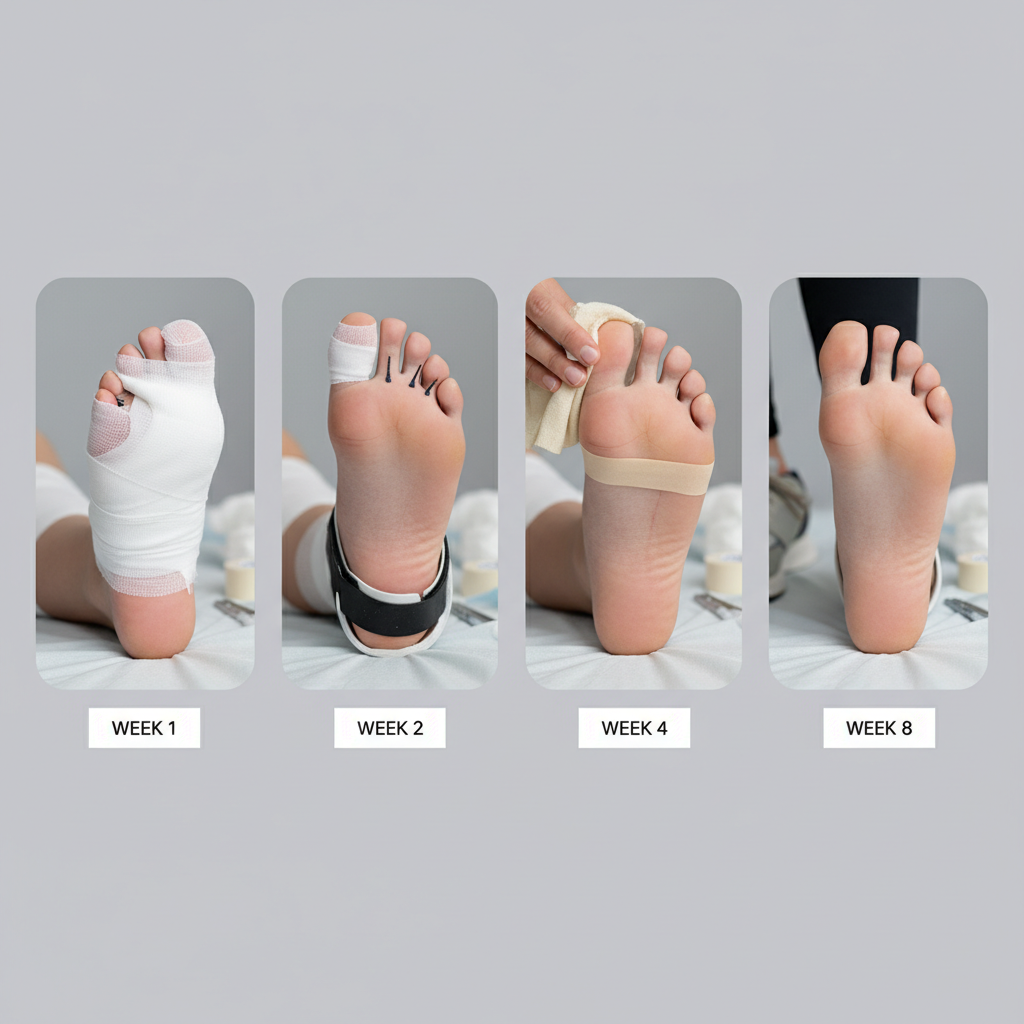
Week 1: First post-op visit
You will usually see your surgeon 5–10 days after surgery to remove the bulky dressing, check the incision, and change to a lighter dressing or splint. Stitches may be removed or replaced with steri-strips.
- Continue aggressive elevation and icing.
- Keep the dressing dry — use a shower cover.
- Watch for warning signs: increasing pain after day 3, drainage, fever over 101°F, or calf pain and swelling (possible blood clot).
Weeks 2–3: Stitches out, swelling peaks
- Stitches typically come out around day 10–14.
- Swelling often peaks in week 2 because you are moving more. This is normal — keep elevating.
- You can usually shower normally once the incision is fully closed.
- Most patients are still in a surgical shoe or boot and using crutches, a knee scooter, or a walker as instructed.
- Driving is generally not allowed yet, especially if it is your right foot.
Weeks 4–6: Transitioning out of the boot
- The first follow-up X-ray confirms the bone is healing in the corrected position.
- Depending on the procedure, you may begin partial or full weight-bearing in the boot.
- Your surgeon may start gentle range-of-motion exercises for the big toe joint to prevent stiffness — this is critical for long-term outcomes.
- Some patients begin transitioning to a wide, stiff-soled athletic shoe near the end of this window.
Weeks 6–8: Back to a regular shoe
- Most patients are cleared to wear a wide, supportive sneaker (think New Balance, HOKA, Brooks) with a soft insole.
- Expect lingering swelling at the end of the day — this is normal and can persist for months.
- Light desk work is usually fine by now; jobs that require prolonged standing may need additional time.
- Driving is typically allowed once you can comfortably and safely operate the pedals without the boot.
Months 3–4: Low-impact activity returns
- Stationary cycling, swimming, and the elliptical are usually allowed.
- Walking distances can gradually increase.
- Formal physical therapy may be prescribed to restore strength, balance, and big toe mobility.
- Avoid running, jumping, and high-impact sports.
Months 4–6: Higher-impact activity
- Many patients are cleared to begin a graded return to running, hiking, tennis, and weight-bearing exercise classes.
- Swelling continues to improve but may still appear after long days.
- Dress shoes with any heel height are typically reintroduced cautiously — pointed-toe and high-heel shoes contributed to the bunion in the first place, so a permanently wider toe box is wise.
Months 6–12: Final healing
- Bone remodeling completes.
- Residual swelling fully resolves for most patients.
- The big toe joint should feel stable and largely pain-free. Some stiffness in the joint is normal and usually improves with continued mobility work.
Returning to work and driving
- Desk job: 1–2 weeks if you can keep the foot elevated.
- Job with standing/walking: 4–8 weeks, sometimes longer.
- Heavy labor: 8–12 weeks.
- Driving: Once off narcotic pain medication AND able to safely operate the pedals — usually 4–6 weeks for right-foot surgery, sometimes sooner for left-foot.
Common setbacks to avoid
- Bearing weight before you are cleared. This is the #1 cause of hardware failure and non-union.
- Stopping elevation too early. Swelling that lingers for months is often elevation-related.
- Skipping toe range-of-motion exercises. A stiff big toe joint is a far harder problem to fix than a slow-to-heal incision.
- Smoking or nicotine use. Nicotine dramatically slows bone healing — many surgeons require you to stop before surgery.
- Returning to high-impact activity too soon. The bone is not fully healed until around 12 weeks, even when you feel great.
When to call your surgeon
Contact the office promptly if you notice:
- Increasing pain, redness, or warmth after the first 3 days
- Drainage from the incision, especially if it smells or is cloudy
- Fever over 101°F
- Calf pain, calf swelling, or sudden shortness of breath (possible blood clot)
- Numbness or tingling that is new or worsening
The bottom line
Bunion surgery recovery is highly predictable when you follow your surgeon's instructions and respect the timeline. Elevate aggressively in the first two weeks, protect the bone while it heals, and move the joint as soon as you are cleared. Patients who do these three things consistently are the ones who walk away with a straight, comfortable foot — and stay that way.
If you are considering bunion surgery in Irvine or anywhere in Orange County, Dr. Eskander offers both traditional and minimally invasive correction tailored to your foot, your activity level, and your recovery goals. Call (949) 774-2890 to schedule a consultation.