
Understanding Ingrown Toenails: Prevention, Home Care, and Surgical Solutions
Learn how to manage and prevent painful ingrown toenails (onychocryptosis). This guide covers proper trimming techniques, safe at-home remedies, and when professional podiatric intervention or surgery is necessary for long-term relief.
Imagine the sharp, stabbing sensation of a needle pressing into your toe with every single step you take. For many, an ingrown toenail starts as a minor nuisance but quickly spirals into a throbbing, red, and swollen ordeal that makes even the loosest shoes feel like torture instruments.
While they may seem like a small cosmetic inconvenience, ingrown toenails (onychocryptosis) are one of the most common reasons patients visit a podiatrist. Left untreated, a simple nail issue can lead to serious bone infections or systemic issues, especially for those with underlying health conditions. Understanding why your nail is "digging in" is the first step toward lasting relief and walking comfortably again.
What's actually happening
At its core, an ingrown toenail occurs when the corner or side of a toenail grows into the soft flesh of the toe rather than resting on top of it. This isn't just a surface-level problem; the nail plate acts like a foreign object, piercing the skin barrier and triggering an inflammatory response from your body.
When the nail edge—often referred to by podiatrists as the "spicule"—breaks the skin, your immune system rushes to the area. This causes the characteristic swelling and redness. If the nail continues to grow deeper, it creates a "portal of entry" for bacteria like Staphylococcus. This is why ingrown nails so frequently become infected, leading to the formation of pus or "granulation tissue," which is a raised, beefy-red bump of over-healing skin that bleeds easily.
The anatomy of the nail is more complex than it looks. The nail grows from the matrix, which is the "root" located under the skin behind your cuticle. If the matrix is curved or damaged, it will continue to produce a nail that is shaped like a staple (a condition called an involuted nail), making recurring ingrowns almost inevitable without professional intervention.
Signs and symptoms to watch for
It is easy to ignore a slightly sore toe, but your body provides clear signals when a nail is transitioning from "irritated" to "infected." Symptoms typically progress through three stages:
- Stage 1 (Early): The skin next to the nail becomes red, slightly swollen, and tender to the touch. You may feel a dull ache when wearing tight shoes.
- Stage 2 (Inflammation): The pain becomes sharp and persistent. The swelling increases, and the toe may feel warm to the touch. You might notice a clear or yellowish fluid draining from the area.
- Stage 3 (Infection): You see visible pus, or the skin has grown over the edge of the nail (granulation tissue). The redness may begin to spread toward the foot, and the pain may throb even when you are resting.
Key takeaway: If you notice red streaks extending from the toe or if you develop a fever, the infection may be spreading into the bloodstream (cellulitis), requiring immediate medical attention.
Causes and risk factors
Why do some people suffer from chronic ingrown nails while others never experience them? Usually, it is a combination of lifestyle choices and genetic "luck of the draw."
Improper Trimming Habits The most common culprit is cutting toenails too short or tapering the corners. When you round the edges of the nail to follow the curve of the toe, you encourage the nail to grow into the skin folds.
Ill-fitting Footwear Shoes that are too tight, narrow, or pointy (like high heels or certain athletic cleats) compress the toes together. This constant pressure forces the nail edge directly into the surrounding soft tissue.
Trauma and Injury Stubbing your toe, dropping a heavy object on your foot, or repetitive pressure from activities like running or ballet can damage the nail bed. This trauma can cause the nail to grow back thickened or de-formed.
Genetics and Nail Shape Some people are simply born with nails that are too large for their toes or nails that naturally curve inward. If your parents suffered from chronic ingrown nails, you are statistically more likely to deal with them as well.
Poor Circulation and Underlying Health Individuals with diabetes or peripheral vascular disease are at a much higher risk for complications. For these patients, even a minor ingrown nail can lead to a non-healing ulcer or gangrene because the body lacks the blood flow necessary to fight off a local infection.
How it's diagnosed
Diagnosing an ingrown toenail is primarily a clinical process. When you visit a podiatrist, the evaluation begins with a physical examination of the toe to determine the stage of the condition.
The doctor will look for signs of infection, such as "fluctuance" (the presence of a pocket of fluid) and excessive skin growth. They will also assess your vascular health by checking the pulses in your feet to ensure you have adequate healing potential.
In some cases, if the infection appears deep or if the nail was damaged by a heavy impact, an X-ray may be ordered. This helps rule out an infection of the bone (osteomyelitis) or a subungual exostosis—a small bone spur under the nail that might be pushing the nail upward and outward.
Treatment options
Treatment for ingrown toenails ranges from simple at-home adjustments to permanent clinical procedures. The "best" option depends on how often the problem recurs and whether an infection is present.
Conservative care
For early-stage ingrown nails without signs of infection (no pus or extreme swelling), you may try home management:
- Warm Soaks: Soak your foot in warm water mixed with Epsom salts for 15 minutes, two to three times a day. This softens the skin and nail.
- Corrective Trimming: If the nail is just beginning to irritate the skin, a podiatrist can carefully trim the offending corner without a full procedure.
- Antibiotic Ointments: Over-the-counter antibiotic creams and a clean bandage can help protect the area while it heals.
Note: Never attempt "bathroom surgery" by using unsterilized tweezers or scissors to dig out the nail. This almost always introduces deeper infection.
Advanced or minimally invasive options
If the nail is painful but you are hesitant about surgery, a podiatrist may utilize a Slant Back procedure. In this technique, the doctor expertly clips only the small portion of the nail that is digging in. While this provides immediate relief, the nail will likely grow back in the same shape within 6 to 8 weeks.
Surgical options
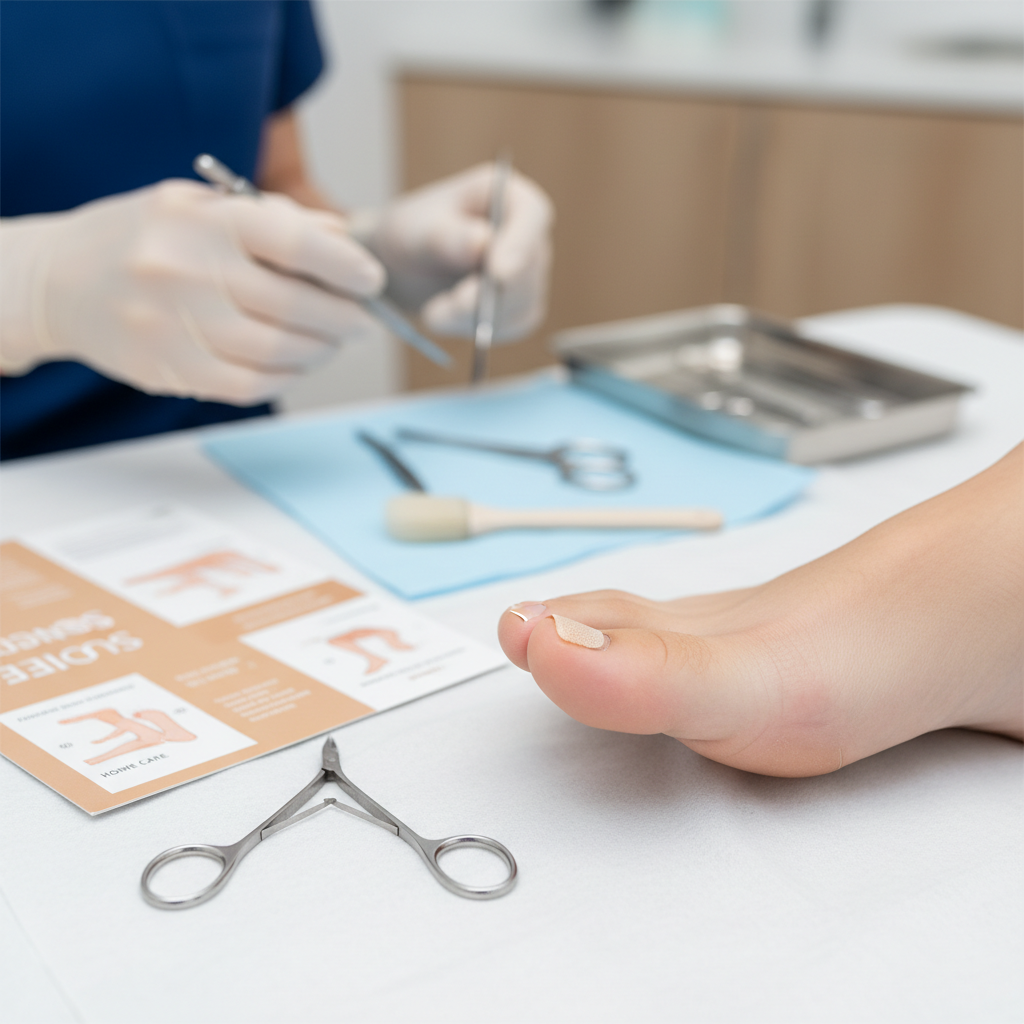
For chronic, recurring, or severely infected nails, a minor in-office procedure is often the most effective and permanent solution.
- Partial Nail Avulsion (PNA): After numbing the toe with a local anesthetic, the podiatrist removes only the narrow sliver of nail that is grew into the skin. The rest of your nail remains intact and looks normal.
- Matrixectomy (Permanent Solution): To prevent the nail from ever growing back into the skin again, a chemical called phenol is applied to the nail root (matrix). This prevents that specific edge of the nail from regrowing, providing a permanent cure for roughly 95% of patients.
- Total Nail Avulsion: In rare cases where the nail is severely fungal, thickened, or deformed across its entire width, the doctor may recommend removing the entire nail plate.
Recovery and what to expect
The most surprising thing for most patients is how quickly they feel better after a professional procedure. Once the "splinter" of the nail is removed, the throbbing usually stops instantly.
- The First 24 Hours: You will leave the office with a large "bulldog" dressing on your toe. You should keep your foot elevated as much as possible to minimize throbbing.
- Days 2-7: You will begin daily soaking in Epsom salts and changing a small bandage. You can typically return to wearing wide-toed shoes or sandals immediately, and most patients return to work or school the next day.
- Weeks 2-4: The drainage will stop, and the skin where the nail used to be will toughen up. During this time, you should avoid swimming in public pools or "dirty" water (like lakes or oceans) to prevent infection.
- Full Healing: The "socket" where the nail was removed usually closes completely within 3 to 6 weeks. If a chemical was used to kill the root, that corner of the toe will simply remain skin, and your remaining nail will look slightly narrower.
Prevention and self-care tips
The goal is to stop the cycle of pain before it starts. You can significantly reduce your risk of a recurrence by following these habits:
- Cut Straight Across: Use toenail clippers with a straight blade rather than a curved one. Never "dig" into the corners.
- Check Your Length: Don't cut your nails too short. Leave them long enough so the corners sit comfortably atop the skin at the end of the toe.
- The Finger-Space Rule: When buying shoes, ensure there is a thumb's width of space between your longest toe and the end of the shoe.
- Protect Your Toes: if you work with heavy equipment or move furniture, wear steel-toed boots or sturdy footwear.
- Moisturize cautiously: Keep the skin around the nails soft, but avoid getting too much lotion between the toes, as excessive moisture can lead to fungal issues.
When to see a podiatrist
Self-care has its limits. You should bypass the Epsom salts and seek professional help immediately if you experience the following:
- You have diabetes, poor circulation, or an autoimmune disorder.
- There is visible pus, drainage, or a foul odor coming from the toe.
- The redness is spreading from the toe onto the foot.
- The pain prevents you from wearing shoes or performing daily activities.
- The ingrown nail keeps coming back every few months.