
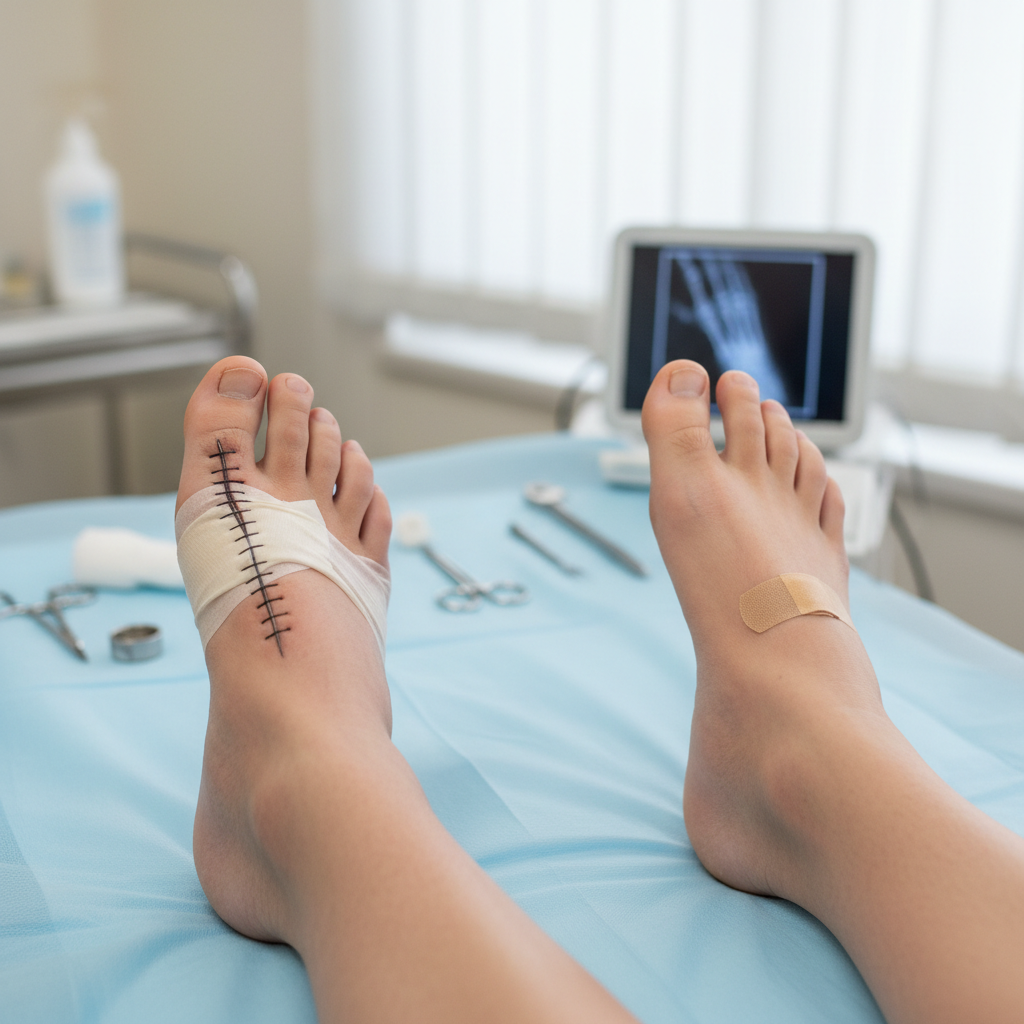
Traditional vs. Minimally Invasive Bunion Surgery: An Irvine Patient's Guide
A side-by-side comparison of traditional open bunion surgery and minimally invasive bunion surgery (MIBS) — covering recovery times, scar visibility, suitability for mild to severe bunions, and how to choose between them with your Irvine foot and ankle surgeon.
Why this decision matters
A bunion (hallux valgus) is more than a cosmetic bump — it's a progressive change in the alignment of the big toe joint that can cause pain, shoe-fitting problems, and arthritis over time. When conservative care (wider shoes, orthotics, padding, activity modification) no longer controls symptoms, surgery becomes the conversation.
Today, Irvine patients researching bunion surgery typically encounter two broad categories:
- Traditional (open) bunion surgery — the long-established approach using an incision over the joint to cut, realign, and fix the bone with screws or plates.
- Minimally invasive bunion surgery (MIBS) — a newer percutaneous technique that corrects the deformity through several small (3–5 mm) incisions using specialized burrs and fixation.
Both can produce excellent, lasting correction. The "best" choice depends on the severity of your bunion, your bone quality, your lifestyle and recovery goals, and your surgeon's experience with each technique.
Traditional (open) bunion surgery
Traditional bunionectomies — including the chevron, scarf, Lapidus, and Akin osteotomies — are the procedures most foot and ankle surgeons have performed for decades. The surgeon makes an incision (typically 4–7 cm) along the inside of the foot, removes the bony prominence, cuts and shifts the first metatarsal into a corrected position, and stabilizes it with one or more screws or a small plate.
Strengths
- Decades of published outcomes data and long-term follow-up.
- Direct visualization of the joint, capsule, and soft tissues.
- Versatile — handles mild, moderate, and severe deformities, including cases with arthritis or instability of the first tarsometatarsal joint (where a Lapidus fusion may be required).
- Predictable, powerful correction for severe bunions and revision cases.
Trade-offs
- A longer incision means a more visible scar along the top or inside of the foot.
- Greater soft-tissue dissection can mean more postoperative swelling and stiffness in the first few weeks.
- Most patients spend 2 weeks non-weight-bearing or in a surgical shoe, transition to a walking boot for 4–6 weeks, and return to regular shoes around 6–8 weeks. Full athletic activity typically resumes at 3–6 months.
Minimally invasive bunion surgery (MIBS)
Minimally invasive bunion surgery uses three to five small percutaneous incisions (each about the width of a pencil tip) through which the surgeon performs the bone cut with a high-speed burr under live fluoroscopy. The metatarsal head is shifted and fixed with two long screws placed across the bone.
Modern third-generation MIBS techniques (sometimes called PECA or MICA) have made the procedure far more reliable than the older percutaneous bunionectomies of the 1980s–90s.
Strengths
- Minimal scarring — incisions typically heal as faint marks rather than a visible line across the foot.
- Less soft-tissue trauma means less postoperative swelling and often less narcotic pain medication.
- Many patients are weight-bearing in a surgical shoe immediately after surgery, transition out of the post-op shoe at 4–6 weeks, and return to athletic shoes around 6–8 weeks.
- Stiffness in the big toe joint tends to be lower at the 3-month mark compared with traditional open techniques.
Trade-offs
- Best suited for mild to moderate bunions with reasonable bone quality. Severe deformities, significant arthritis, or first-ray hypermobility may still require an open Lapidus or other traditional procedure.
- Technically demanding — outcomes depend heavily on surgeon experience and case volume with the specific MIBS system being used.
- Long-term (10+ year) outcome data is still maturing compared with traditional osteotomies, though 5-year data is very encouraging.
Side-by-side comparison
| Factor | Traditional (Open) | Minimally Invasive (MIBS) |
|---|---|---|
| Incision size | 4–7 cm single incision | 3–5 incisions, each ~3–5 mm |
| Scar visibility | Visible line on top/inside of foot | Faint dots, often unnoticeable once healed |
| Anesthesia | Ankle block + sedation, or general | Ankle block + sedation, or general |
| Weight-bearing | Often non-weight-bearing or surgical shoe for 2 weeks | Immediate weight-bearing in surgical shoe |
| Return to sneakers | ~6–8 weeks | ~6–8 weeks |
| Return to sport / running | 3–6 months | 3–6 months |
| Best for | Moderate to severe bunions, arthritis, hypermobility, revisions | Mild to moderate bunions with healthy bone |
| Hardware | 1–2 screws or small plate | 2 long screws |
Recovery timeline at a glance
The first two weeks are the most restrictive regardless of technique — elevation, icing, and limited activity protect the bone cut while it begins to heal. By 6 weeks, X-rays usually confirm enough bone healing to transition into a supportive athletic shoe. Three months is when most patients feel like the foot is "theirs" again, and six months to one year is when final swelling resolves and athletic performance returns to baseline.
The biggest practical differences between the two approaches show up in weeks 2–6: MIBS patients often walk more comfortably in a surgical shoe and report less swelling, while traditional surgery patients may rely more on a walking boot and crutches early on.
How to choose: questions to ask your surgeon
If you're researching bunion surgery in Irvine, bring these questions to your consultation:
- How severe is my bunion on imaging? Ask to see your intermetatarsal and hallux valgus angles — they directly influence which procedures are appropriate.
- Am I a candidate for minimally invasive bunion surgery? Not every bunion is, and an honest answer matters more than a sales pitch.
- How many MIBS cases do you perform per year? Surgeon volume strongly predicts outcomes for any newer technique.
- What's your specific weight-bearing and shoe protocol? Protocols vary; you need to know what your recovery will actually look like.
- What happens if I need revision surgery later? A surgeon who handles both open and minimally invasive techniques can offer the full menu of solutions.
The bottom line for Irvine patients
There is no single "best" bunion surgery — there is the right surgery for your foot. Minimally invasive bunion surgery offers genuine advantages in scar appearance and early comfort for the right candidates, while traditional open techniques remain the gold standard for severe deformities, arthritic joints, and complex revisions.
At Eskander Foot & Ankle, every bunion consultation starts with weight-bearing X-rays, a careful exam of the first ray, and an honest conversation about which technique gives you the most reliable, durable correction.
If you're considering bunion surgery in Irvine or anywhere in Orange County, schedule a consultation to review your imaging and discuss whether a traditional or minimally invasive approach fits your foot, your goals, and your timeline.