
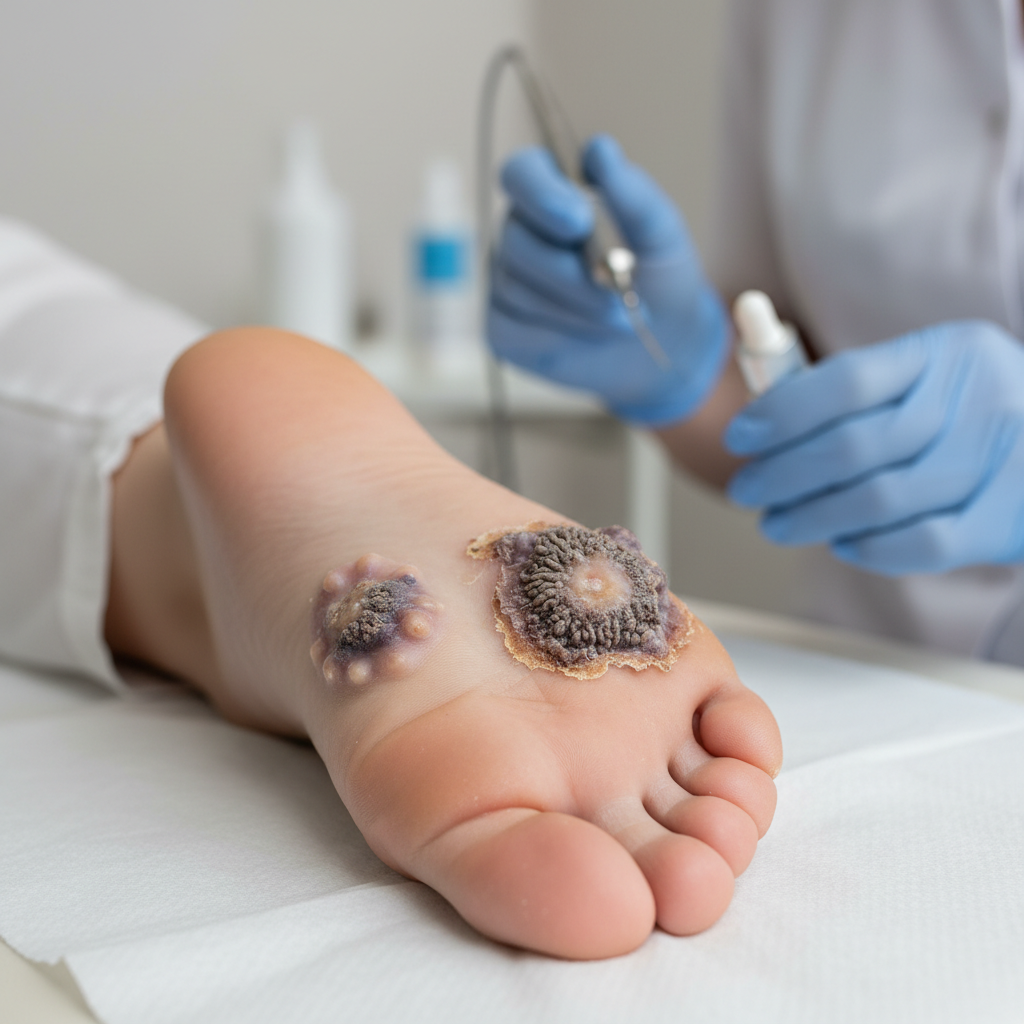
Stubborn Plantar Warts: Effective Treatments for Warts That Won't Go Away
Struggling with a persistent plantar wart? Learn why these painful growths resist home remedies and explore advanced clinical treatments, from cryotherapy to surgical excision, to finally clear your skin and walk pain-free.
That small, grainy bump on the bottom of your foot might feel like you are walking on a sharp pebble every time you take a step. While many skin issues resolve on their own, plantar warts are notorious for their persistence, often lingering for months or even years despite your best efforts to treat them at home.
What's actually happening
Plantar warts are noncancerous skin growths caused by the Human Papillomavirus (HPV), specifically types 1, 2, 4, 60, or 63. The virus enters the body through tiny cuts or weak spots on the soles of the feet. Once inside, the virus invades the keratinocytes—the primary cells of the epidermis—causing them to multiply rapidly and form a hard, thickened lesion.
Unlike warts on your hands, plantar warts are pushed inward by the pressure of your body weight. This pressure causes the wart to grow deep into the dermis and often leads to the formation of a callus over the top of the lesion. The small black dots often seen in the center are not "seeds," but rather tiny, clotted blood vessels (petechiae) that have been drawn up into the growth.
Signs and symptoms to watch for
Identifying a plantar wart correctly is the first step toward effective treatment. Look for these common indicators:
- A small, fleshy, rough, and grainy lesion on the bottom of the foot.
- Hard, thickened skin (callus) over a well-defined "spot" where a wart has grown inward.
- Pinpoint black dots, which are commonly called wart seeds.
- Pain or tenderness when walking or standing.
- A lesion that interrupts the normal ridges and lines (fingerprints) of the skin on your foot.
Causes and risk factors
Anyone can develop a plantar wart, but the virus thrives in warm, moist environments. You are most likely to encounter the virus in communal areas such as locker rooms, public showers, and swimming pool decks.
Risk factors that increase your susceptibility include:
- Having a weakened immune system that cannot effectively fight off the HPV virus.
- Frequently walking barefoot in public damp areas.
- Having previous history of plantar warts, as the virus can remain dormant.
- Skin trauma or cracks on the soles of the feet that provide an entry point for the virus.
How it's diagnosed
A podiatrist can usually diagnose a plantar wart through a simple physical examination. Because these warts can sometimes mimic other conditions like corns or even rare skin malignancies, a specialist may use a scalpel to pare away a small layer of the thickened skin. If the characteristic black dots (clotted capillaries) appear, the diagnosis is confirmed. In rare cases where the lesion is atypical or resistant to all forms of therapy, a small punch biopsy may be performed to rule out other skin pathologies.
Key Takeaway: Plantar warts are viral infections, not just calluses. Because the virus hides from the immune system within the skin layers, professional intervention is often necessary to trigger a proper healing response.
Treatment options
When home remedies like salicylic acid patches fail, clinical intervention becomes necessary to eliminate the viral reservoir.
Conservative care
Professional-strength salicylic acid is often the first line of defense. Unlike over-the-counter versions, clinical applications are more concentrated and are applied after professional debridement (removing the dead skin layers). This allows the medication to penetrate deeper into the viral site. Another common approach is cryotherapy, where liquid nitrogen is used to freeze the wart. This creates a blister around the lesion, eventually causing the dead tissue to slough off over one to two weeks.
Advanced and minimally invasive options
For stubborn warts, your podiatrist may utilize immunotherapy. This involves applying chemicals like squaric acid or injecting antigens (such as the mumps or Candida skin test antigen) directly into the wart. This "wakes up" your immune system, teaching it to recognize and attack the HPV virus at that specific site. Laser therapy is another modern option, using a focused beam of light to cauterize the tiny blood vessels feeding the wart, essentially starving the growth until it dies.
Surgical options
If a wart is particularly large or resistant to other methods, curettage and electrodesiccation may be recommended. In this minor office procedure, the area is numbed with a local anesthetic, and the wart is physically scooped out with a small, spoon-shaped tool (curette). The base is then cauterized to destroy any remaining viral cells and prevent bleeding. While effective, this is usually reserved for cases where other treatments have failed.
Recovery and what to expect
Recovery depends heavily on the treatment method used. For cryotherapy or acid treatments, you may experience mild soreness for 24 to 48 hours, but you can usually return to normal activities immediately. If surgical excision is performed, you may need to offload the area for a few days to allow the skin to close.
It is important to understand that because warts are viral, they have a high recurrence rate. A realistic timeline for complete clearance of a stubborn wart is often 4 to 12 weeks, requiring multiple treatment sessions to ensure every viral cell is eradicated.
Prevention and self-care tips
- Wear shoes in public areas: Always wear flip-flops or water shoes in locker rooms and pool areas.
- Keep feet dry: Change your socks daily and use foot powder if your feet sweat excessively.
- Don't pick at warts: Touching or picking at a wart can spread the virus to other parts of your body or to other people.
- Disinfect your tools: If you use a pumice stone or nail clipper on a wart, do not use it on healthy skin or share it with others.
- Boost your immune health: A healthy immune system is your best defense against viral skin infections.
When to see a podiatrist
You should seek professional care if you notice any of the following:
- The lesion is bleeding, painful, or changing in color.
- You have tried over-the-counter treatments for several weeks with no improvement.
- The wart interferes with your daily activities or exercise routine.
- You have diabetes or poor sensation in your feet (neuropathy).
- You have a weakened immune system due to medication or underlying health conditions.
- The wart is spreading or multiplying into "mosaic" clusters.