
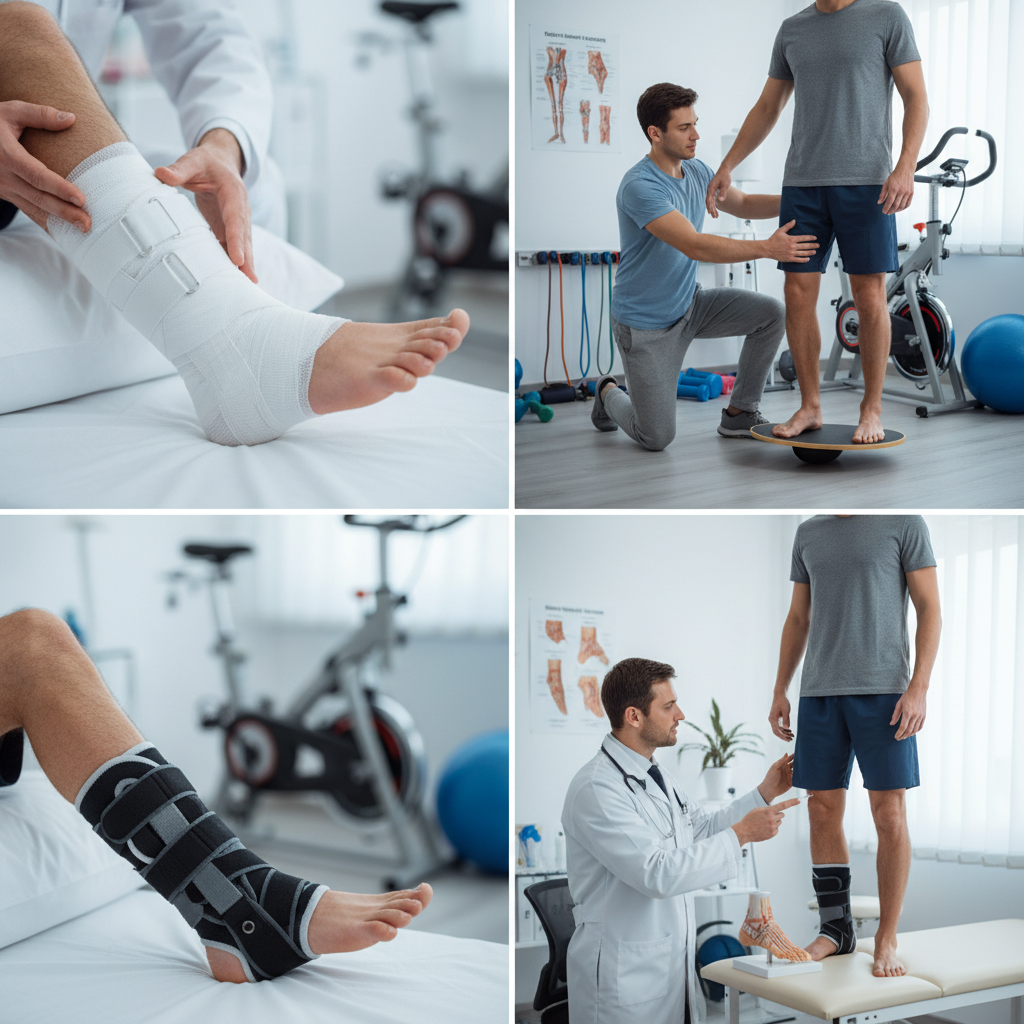
Navigating Ankle Sprain Recovery: From Initial Injury to Full Stability
Recovering from an ankle sprain requires more than just rest. Learn about the stages of ligament healing, the role of bracing and physical therapy, and how to identify signs that your injury requires professional podiatric intervention.
That sudden, sickening pop followed by a sharp jolt of pain is a universal signal that your ankle has reached its limit. While many dismiss a sprain as a minor setback, failing to rehabilitate these stretched or torn ligaments properly can lead to a lifetime of chronic instability and recurring injury.
What's actually happening
An ankle sprain occurs when the foot twists, rolls, or turns beyond its normal range of motion, forcing the tough bands of tissue called ligaments to stretch or tear. Most commonly, this affects the lateral side of the ankle, specifically the anterior talofibular ligament (ATFL). According to the American Academy of Orthopaedic Surgeons (AAOS), these injuries are graded by severity: Grade 1 involves microscopic tearing, Grade 2 is a partial tear, and Grade 3 is a complete rupture of the ligament.
When the ligament is compromised, the mechanical stability of the joint is lost. Furthermore, the nerve endings within the ligament—which provide proprioception, or your brain's sense of where your foot is in space—are damaged. This is why an improperly healed ankle often feels 'wobbly' or untrustworthy even after the initial pain subsides.
Signs and symptoms to watch for
The severity of a sprain isn't always reflected by the amount of immediate pain. You should monitor your injury for these specific indicators:
- Immediate swelling: Puffiness around the 'knob' of the ankle bone (malleolus).
- Bruising and discoloration: This may travel down toward the toes due to gravity.
- Tenderness to touch: Sharp pain when pressing on the ligament site.
- Instability: A feeling that the ankle is 'giving way' when you attempt to stand.
- Restricted range of motion: Inability to flex or rotate the foot comfortably.
Causes and risk factors
While sports like basketball and soccer are high-risk due to rapid pivoting, everyday hazards are equally responsible for sprains. Walking on uneven Irvine sidewalks, wearing improper footwear, or having naturally high arches can increase your susceptibility.
Previous injuries are the most significant risk factor. Once a ligament is stretched, it remains elongated unless specific rehabilitation exercises are performed to strengthen the surrounding musculature. This creates a cycle of 'recurrent sprains' that can eventually lead to early-onset osteoarthritis in the joint.
How it's diagnosed
Professional diagnosis begins with a physical examination where a podiatrist performs 'stress tests' to check the laxity of the joint. Imaging is often necessary to rule out more complex issues. While X-rays are used to identify fractures or 'avulsion' injuries (where the ligament pulls a piece of bone away), an MRI may be required to visualize the extent of soft tissue damage or to check for cartilage lesions inside the joint.
Treatment options
Conservative care
The gold standard for early-stage recovery is the R.I.C.E. protocol (Rest, Ice, Compression, Elevation). During the first 48 to 72 hours, the goal is to control inflammation. Once the acute phase passes, functional rehabilitation begins. This involves specific exercises designed to restore balance and strength to the peroneal muscles on the outside of the leg.
Advanced/minimally invasive options
For patients with significant swelling or slow healing, a podiatrist may utilize custom-molded orthotics to neutralize the foot's position or prescribe medical-grade bracing. Bracing provides the external support the damaged ligaments cannot currently offer, allowing for earlier weight-bearing which actually promotes faster tissue remodeling than total immobilization.
Surgical options
Surgery is rarely the first line of treatment but becomes necessary for Grade 3 tears that do not respond to physical therapy or for athletes with chronic instability. Procedures often involve a Brostrom repair, where the surgeon tightens the existing ligaments to restore the ankle's natural tension and 'lock' the joint back into place.
Key Takeaway: The goal of recovery isn't just to stop the pain; it is to retrain the nerves and muscles to protect the joint from the next 'roll' before it happens.
Recovery and what to expect
Recovery is a marathon, not a sprint. A typical timeline for a moderate sprain follows these stages:
- Phase 1 (Week 1): Protecting the joint and reducing swelling through bracing and elevation.
- Phase 2 (Weeks 2-4): Restoring range of motion and beginning gentle weight-bearing exercises.
- Phase 3 (Weeks 4-8): Advanced proprioceptive training (like standing on one leg) and a gradual return to impact activities.
Full ligament maturation can take up to 12 months, meaning you may need to wear a supportive brace during high-impact sports long after the pain is gone.
Prevention and self-care tips
- Warm up properly: Never jump into high-intensity movement with cold muscles.
- Choose the right gear: Ensure your athletic shoes are appropriate for the specific surface you are playing on.
- Strengthen your core: Better balance starts at the hips and core, which stabilizes your entire gait.
- Listen to your body: If your ankle feels fatigued or 'loose' during a workout, stop immediately.
When to see a podiatrist
While minor tweaks may resolve at home, you should seek professional care if you experience:
- An inability to take more than four steps without significant pain.
- Pain directly over the bony prominences of the ankle.
- Numbness or tingling in the foot or toes.
- Swelling that does not improve after 3 days of R.I.C.E.
- A history of multiple sprains on the same side.