
Is It Safe to Pop a Blister on Your Foot? A Guide to Safe Healing
Discover whether you should pop that painful foot blister, the risks of infection, and how to safely treat friction blisters at home. Learn when a blister requires professional medical attention from a podiatrist to ensure proper healing.
That stinging, fluid-filled bubble on your heel or toe can turn a simple walk into a painful ordeal, tempting you to reach for a needle just to find some relief. While the urge to pop a blister is strong, doing so prematurely can transform a minor irritation into a serious infection that threatens your mobility.
What's actually happening
A blister, or vesicle, is your body's ingenious way of protecting damaged skin. When friction or heat irritates the upper layers of the skin (the epidermis), the body responds by leaking serum—a clear, nutrient-rich fluid—into the space between the layers. This fluid acts as a natural cushion or 'biological bandage,' shielding the raw, sensitive skin underneath while it regenerates. According to the American Academy of Dermatology, the skin covering the blister is the best possible barrier against bacteria.
Signs and symptoms to watch for
Most blisters are small and clear, but they can change appearance if they become irritated or infected. Watch for these common signs:
- A raised bubble filled with clear fluid or blood (blood blister).
- Tenderness or localized pain when pressure is applied.
- Redness and inflammation around the edges of the bubble.
- A 'hot' sensation in the specific area of the skin.
Causes and risk factors
Blisters on the feet are primarily caused by friction. When your skin rubs against a sock or shoe repeatedly, the layers of skin separate. Several factors increase your risk:
- Ill-fitting footwear: Shoes that are too tight or too loose create constant rubbing points.
- Moisture: Sweaty feet soften the skin, making it more susceptible to tearing.
- Activity level: Long-distance running or hiking places repetitive stress on specific areas like the hallux (big toe) or heel.
- Medical conditions: Patients with diabetes or peripheral neuropathy may not feel the friction occurring, leading to larger, more severe blisters before they are noticed.
How it's diagnosed
A podiatrist can typically diagnose a friction blister through a simple physical examination. During your visit, the doctor will assess the size, location, and color of the fluid. They will also look for signs of secondary infection, such as cellulitis or purulent drainage (pus). If you have underlying conditions like diabetes, the diagnostic process may include checking your circulation and nerve sensation to ensure the blister isn't the start of a more complex foot ulcer.
Treatment options
Conservative care
The gold standard for blister care is to leave it alone. If the blister is intact, cover it loosely with a bandage or a 'donut' shaped moleskin pad to relieve pressure. If the blister has already popped on its own, do not peel away the 'roof' of the skin. Instead, clean the area with mild soap and water, apply an antibiotic ointment, and cover it with a sterile dressing.
Advanced/minimally invasive options
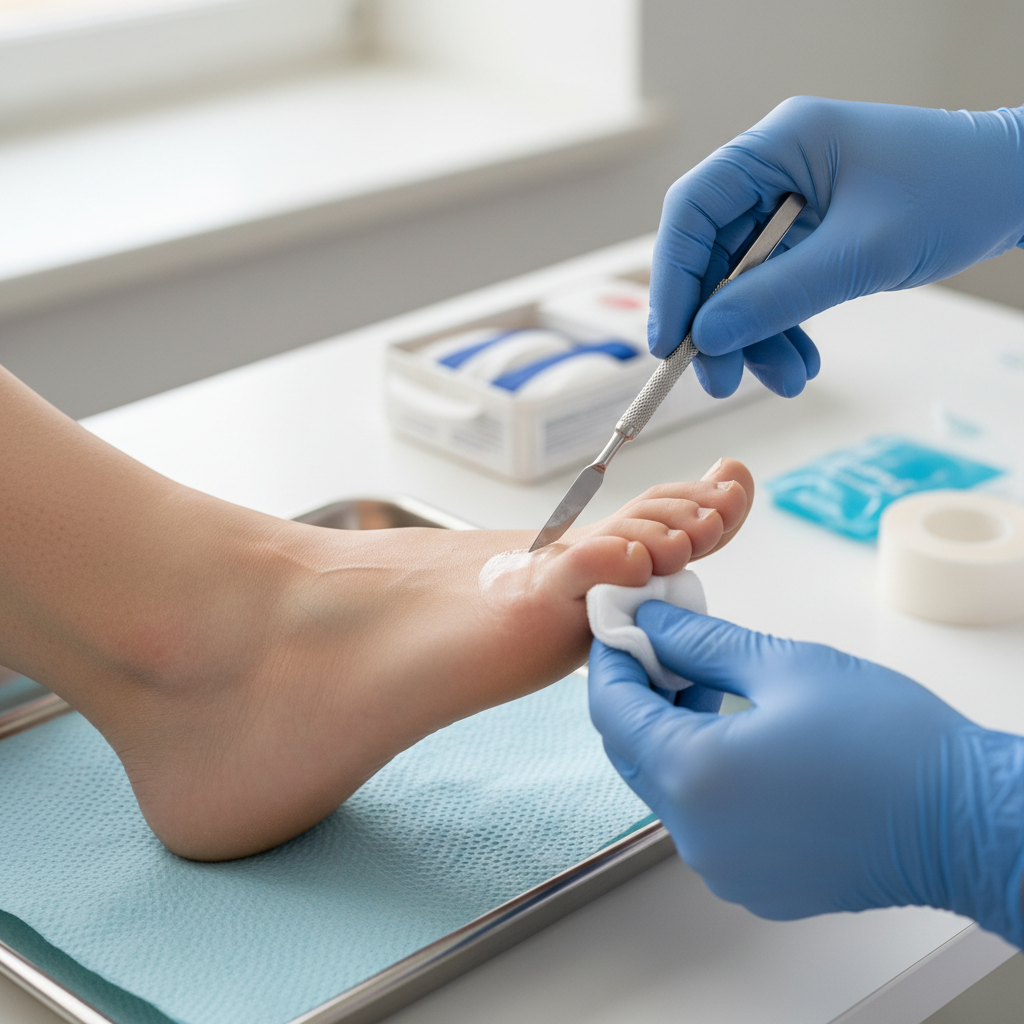
If a blister is exceptionally large, tense, or located on a weight-bearing surface that makes walking impossible, a podiatrist may perform a controlled drainage. This involves using a sterile surgical blade or needle to create a small puncture, allowing the fluid to escape while keeping the overlying skin intact to serve as a protective layer. This is significantly safer than 'bathroom surgery' because it is performed in a sterile environment.
Surgical options
Surgery is rarely required for standard friction blisters. However, if a blister leads to a deep-tissue infection or an abscess, a podiatrist may need to perform an incision and drainage (I&D) or debridement to remove dead tissue and ensure the wound can heal from the inside out.
Key Takeaway: The fluid inside a blister is sterile and protective. Popping it opens a 'doorway' for bacteria to enter your bloodstream, which is why keeping the skin intact is almost always the safest choice.
Recovery and what to expect
A typical friction blister takes about 7 to 10 days to heal completely. Within the first few days, your body will begin to reabsorb the fluid, and the 'roof' of the blister will eventually dry up and peel off naturally once the new skin underneath is ready. During this time, it is vital to avoid the activity or footwear that caused the blister in the first place to prevent further trauma to the site.
Prevention and self-care tips
Preventing blisters is far easier than treating them. Follow these actionable steps:
- Wear moisture-wicking socks: Avoid cotton, which traps sweat; choose synthetic blends or wool instead.
- Ensure proper shoe fit: Buy shoes in the afternoon when your feet are slightly swollen to ensure they aren't too tight.
- Use lubricants: Apply petroleum jelly or specialized anti-friction sticks to 'hot spots' before long walks.
- Double-up: Some hikers wear a thin liner sock under a thicker sock to move the friction point away from the skin.
When to see a podiatrist
While most blisters heal on their own, certain red flags require professional intervention:
- You have diabetes or poor circulation (never self-treat a blister in these cases).
- The blister is filled with yellow or green pus.
- Red streaks are radiating away from the blister site.
- The pain is increasing rather than decreasing over time.
- You develop a fever or chills alongside the foot pain.