
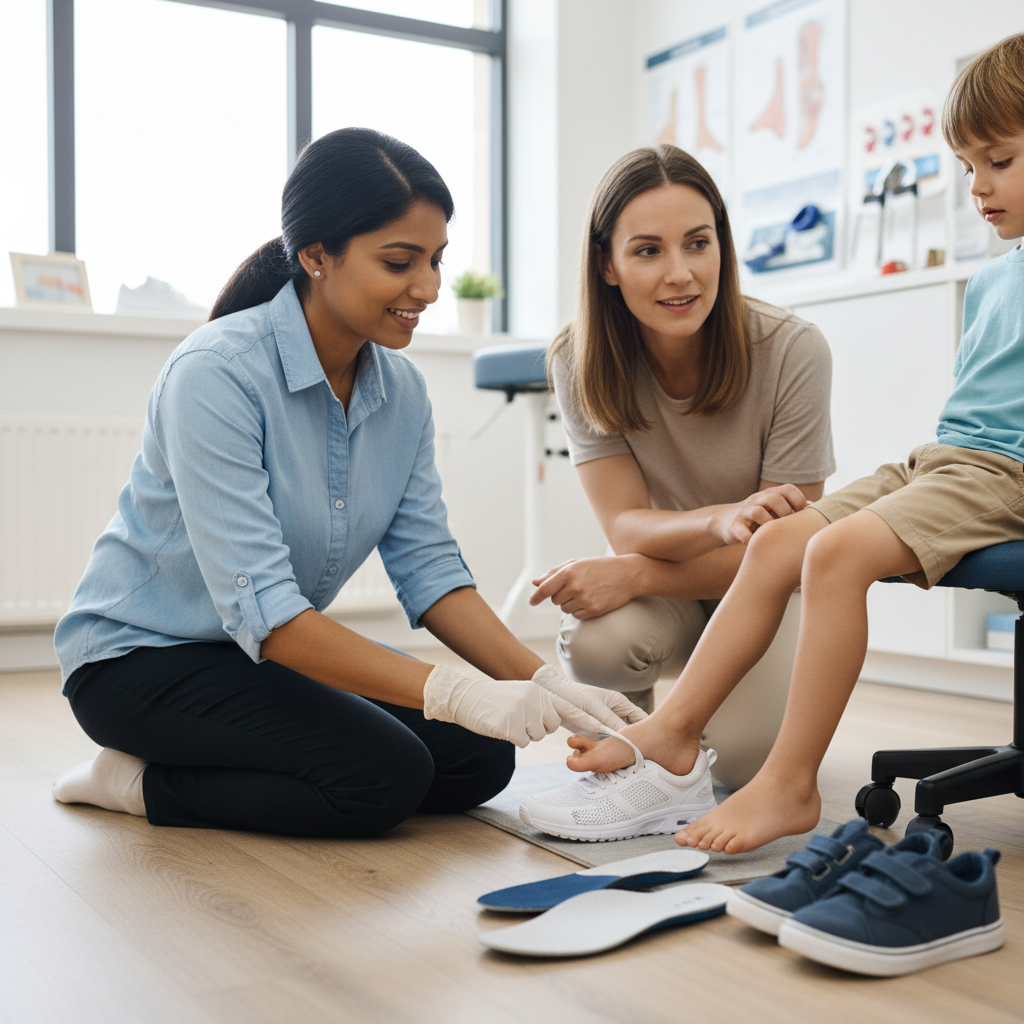
How to Choose Shoes and Insoles for Children's Developing Feet: A Parent's Expert Guide
A podiatrist-written guide for parents on picking the right shoes and insoles for kids — from toddler flat feet to growing arches, when to worry, and when custom orthotics actually help.
Most children are born with flat feet, and most of them grow out of it. As a foot and ankle surgeon in Irvine, one of the most common questions I hear from parents is some version of: "Does my child need special shoes or insoles?" The honest answer is usually no — but knowing when the answer flips to yes is the difference between a normal childhood and avoidable foot pain.
This guide walks you through what to look for in kids'' shoes, when insoles actually help, and the red flags that warrant a visit to a pediatric podiatrist.
How children''s feet actually develop
A child''s foot is not a small adult foot. The bones are still partly cartilage and don''t fully ossify until around age 18. The arch typically develops between ages 3 and 6 as the foot muscles strengthen and the fat pad under the arch thins out.
That''s why the "flat feet" you see in your toddler are almost always flexible flatfoot — perfectly normal, painless, and self-correcting. According to the American Academy of Orthopaedic Surgeons, flexible flatfoot in children rarely needs treatment.
What to look for in a child''s shoe
Forget marketing terms like "arch support technology" for toddlers. Pediatric podiatrists and the American Podiatric Medical Association agree on a short, practical checklist:
- Flexible sole. You should be able to bend the toe of the shoe up toward the laces. A stiff sole forces the foot to work against the shoe instead of with it.
- Wide toe box. Toes need room to splay. Pinched toes encourage ingrown nails and bunion-like deformities later.
- Lightweight. Heavy shoes change a child''s gait.
- Breathable material. Leather or mesh — not plastic.
- Secure closure. Velcro or laces that actually hold the heel in place.
- Thumb''s width of room at the longest toe. Check every 2–3 months for kids under 6 — they outgrow shoes fast.
What you do not need for a healthy child: arch supports, motion-control shoes, ankle-stabilizing high tops, or "corrective" orthotics. These don''t accelerate arch development and can actually weaken the foot muscles that do.
When insoles help — and when they don''t
There are three categories of insoles for kids, and only one is podiatrist-prescribed.
1. Cushioned insert (over-the-counter)
Soft gel or foam inserts you buy at the drugstore. Useful for an active older child with mild fatigue after sports, or to make a shoe fit better. Not treating a medical condition.
2. Pre-fabricated arch support (over-the-counter)
Firmer, with a built-up arch. Useful in narrow cases — usually an older child with painful flexible flatfoot who isn''t a candidate yet for custom orthotics. They''re a trial, not a diagnosis.
3. Custom orthotics (prescribed)
Molded to your child''s foot from a 3D scan or cast. Necessary for a small group of kids with:
- Painful flexible flatfoot that hasn''t responded to stretching and supportive shoes
- Rigid flatfoot (often from a tarsal coalition — the bones of the back of the foot fused together)
- Severe in-toeing or out-toeing affecting walking
- Tight Achilles tendons causing toe-walking
- Neurological conditions like cerebral palsy
- Significant leg-length difference
In our Irvine office we don''t prescribe custom orthotics for a child unless the foot is symptomatic — meaning pain, tripping, refusing to walk, or visible asymmetry. Putting expensive orthotics in an asymptomatic kid''s shoe doesn''t improve their long-term foot health.
Red flags: when to see a pediatric podiatrist
Bring your child in if you notice any of the following:
- Pain in the feet, ankles, or lower legs (especially after activity)
- One foot looks noticeably different from the other
- The arch doesn''t appear when your child stands on tiptoe (suggests rigid flatfoot)
- Persistent toe-walking past age 3
- Frequent tripping or refusing to participate in sports
- Unusual shoe-wear patterns — the inside of the heel worn down, or the shoe leaning inward
- Heel pain in a 9–14 year old, especially an athlete (could be Sever''s disease — calcaneal apophysitis, very treatable and self-limited)
- Ingrown toenails that keep coming back
These are the cases where a 20-minute exam saves months of guesswork — and where the right insoles or shoe changes actually help.
Sports shoes for active kids
For organized sports, pick a shoe designed for the dominant motion of that sport: cleats for soccer, court shoes for basketball or tennis, running shoes for cross-country. A general "athletic shoe" is fine for PE and recess but isn''t built for repetitive lateral cutting.
If your child plays a sport more than three times a week and complains of heel or arch pain, that''s worth an evaluation — not another over-the-counter insole.
The short version
- Most kids don''t need arch supports. A flexible, well-fitting shoe with a wide toe box is enough.
- Custom orthotics are a medical device, not a wellness product. They help a specific group of children — not all of them.
- Pain, asymmetry, persistent toe-walking, or unusual shoe wear are the reasons to call a podiatrist.
- Check shoe fit every 2–3 months under age 6, every 4 months after that.
If your child is having foot pain, walking oddly, or you''re just not sure whether what you''re seeing is normal, we''re happy to take a look. Most of our pediatric visits in Irvine end with reassurance and a few simple stretches — not a prescription.
Call (949) 774-2890 to schedule a pediatric foot evaluation with Dr. Andrew N. Eskander, DPM. We see kids from Irvine, Tustin, Newport Beach, and across Orange County.