
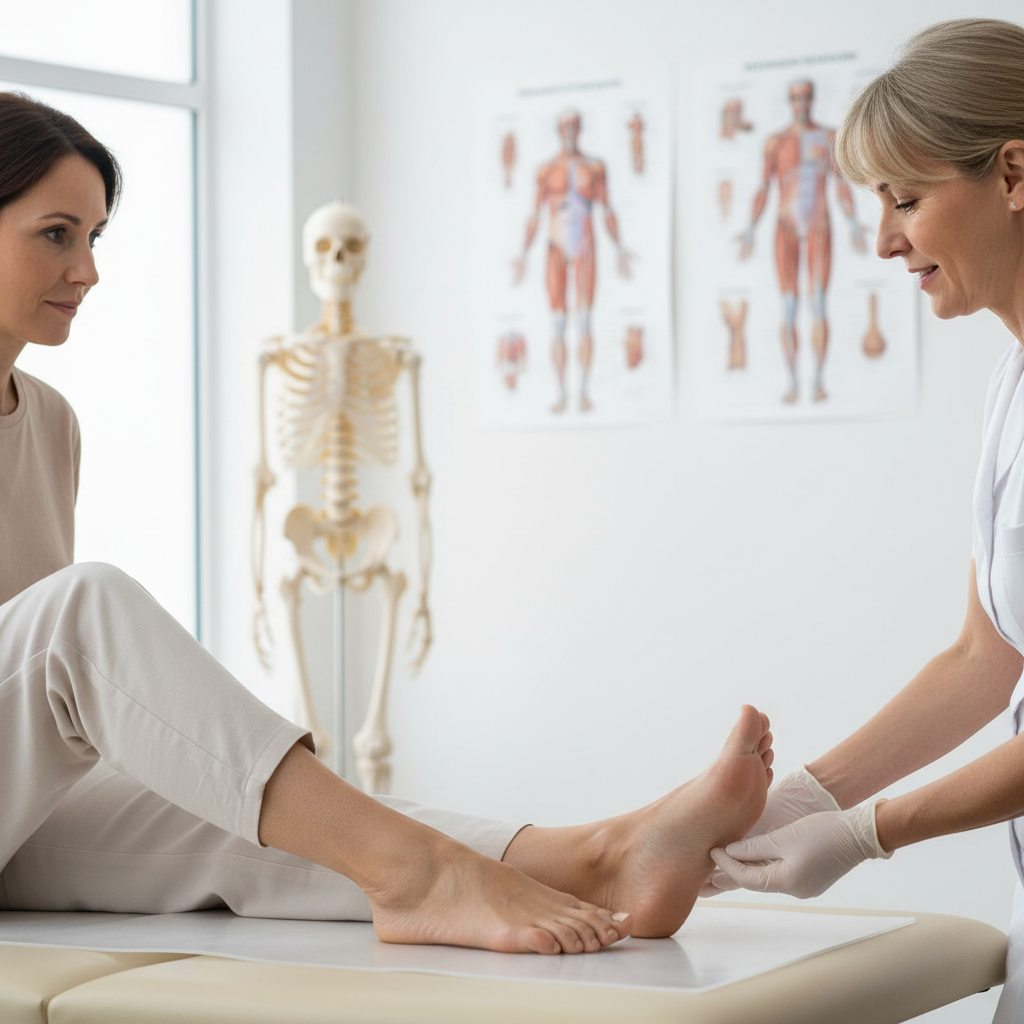
Are Flat Feet the Hidden Cause of Your Knee and Back Pain?
Discover how flat feet, or fallen arches, can trigger a chain reaction of misalignment leading to chronic knee and lower back pain. Learn about the biomechanics of overpronation and the modern treatment options available to restore your mobility.
That persistent ache in your lower back or the sharp twinge in your knee might not start where you think it does; often, the culprit is hiding right beneath your heels. When your arches collapse, it sets off a kinetic chain reaction that forces your entire skeleton to compensate for an unstable foundation.
What's actually happening
Your feet are the structural foundation of your entire body. In a healthy foot, the medial longitudinal arch acts as a natural shock absorber, distributing the force of every step you take. When you have flat feet (pes planus), that arch is either absent or collapses during movement.
This collapse leads to a mechanical issue called overpronation. As the foot rolls inward excessively, it forces the large bone of the lower leg (tibia) to rotate inward as well. This internal rotation travels up the leg, putting torsional stress on the knee joint and tilting the pelvis forward. This misalignment, often referred to as the "kinetic chain" effect, forces the muscles in your lower back to work overtime to keep you upright, eventually leading to chronic strain and pain.
Key Takeaway: Your body functions as a single mechanical unit; a lack of support at the ground level forces the knees and spine to absorb impact they weren't designed to handle.
Signs and symptoms to watch for
Flat feet don't always cause pain immediately, but over time, the mechanical wear and tear becomes evident. You may notice:
- Visible loss of the arch when standing, even if it appears when sitting.
- Uneven wear on the inner soles of your shoes.
- Swelling or tenderness along the inner ankle.
- A "clumsy" gait or frequent tripping.
- Aching in the lower back that worsens after long periods of standing.
- Pain on the inside of the knee joint during or after exercise.
Causes and risk factors
While many people are born with flat feet due to genetics, others develop "fallen arches" later in life. Common factors include:
- Posterior Tibial Tendon Dysfunction (PTTD): The most common cause of adult-acquired flatfoot, where the tendon supporting the arch becomes inflamed or torn.
- Obesity: Excess weight puts constant, heavy pressure on the structural ligaments of the foot.
- Aging: Over time, the ligaments that hold the bones of the foot together naturally stretch and weaken.
- Physical Trauma: Previous injuries to the foot or ankle can permanently alter the arch structure.
- Rheumatoid Arthritis: Inflammatory conditions can attack the small joints in the foot, causing the arch to collapse.
How it's diagnosed
Diagnosis begins with a comprehensive biomechanical assessment. A podiatrist will observe your gait (how you walk) and perform a "too many toes" test, looking at your feet from behind to see if the toes peek out to the side due to heel misalignment. Imaging such as X-rays is often used to measure the degree of collapse and check for secondary issues like arthritis or bone spurs. In complex cases, an MRI may be ordered to evaluate the health of the posterior tibial tendon.
Treatment options
Conservative care
For many patients, non-invasive strategies are highly effective at realigning the kinetic chain. This often involves custom orthotics, which are medical-grade shoe inserts designed to provide the specific arch support your foot lacks. Unlike over-the-counter inserts, custom versions are molded to your unique foot shape to reposition the heel and stabilize the arch. Physical therapy is also vital, focusing on strengthening the posterior tibial tendon and stretching a tight Achilles tendon, which often contributes to arch collapse.
Advanced/minimally invasive options
If conservative measures aren't enough, modern podiatry offers bridge treatments. Bracing can provide external stabilization for those with significant tendon weakness. Additionally, regenerative medicine injections may be used to treat inflammation in the supporting ligaments, helping to stabilize the foot without the need for major reconstruction.
Surgical options
When the structural deformity is severe or the pain is debilitating, surgery may be necessary. Procedures range from tendon repairs and ligament reconstructions to bone grafts (osteotomies) that physically recreate the arch. In cases of severe instability or advanced arthritis, a fusion (arthrodesis) may be performed to permanently stabilize the foot joints.
Recovery and what to expect
Recovery depends entirely on the intervention. With custom orthotics, most patients feel a significant reduction in knee and back strain within 2 to 4 weeks as their muscles adjust to the new alignment. If surgery is required, the timeline is longer. You may spend 6 to 12 weeks in a cast or walking boot, followed by several months of physical therapy. Most patients return to full activity and high-impact sports within 6 to 9 months, often finding they can move more comfortably than they have in years.
Prevention and self-care tips
- Choose supportive footwear: Avoid flat, unsupportive shoes like flip-flops or worn-out sneakers for daily activities.
- Maintain a healthy weight: Reducing the load on your arches prevents further collapse.
- Stretch your calves: Tight calf muscles pull on the heel and flatten the arch; daily stretching can mitigate this.
- Perform foot exercises: Practice "towel curls" with your toes to strengthen the intrinsic muscles of the foot.
- Replace shoes regularly: Most athletic shoes lose their structural integrity after 300 to 500 miles of use.
When to see a podiatrist
- You have persistent pain in your feet, knees, or lower back that doesn't improve with rest.
- One foot appears significantly flatter than the other.
- You find it difficult or painful to stand on your tiptoes.
- Your feet feel stiff or numb after short walks.
- You notice a new bump or protrusion on the inner side of your foot.